
ACH Transfer Limits Explained


ACH transfers are one of the most common ways Americans move money between bank accounts, but the limits attached to these transfers are often misunderstood, inconsistent across institutions, and easy to run into at the worst possible moment.
Whether you are paying a contractor, moving savings between banks, or sending money to a family member, understanding how ACH transfer limits work can help you plan ahead and avoid delays. These limits are not set by a single universal rule. They come from a combination of federal oversight, network guidelines, and individual bank policies, which means the experience can vary significantly depending on where you bank.
What Is an ACH Transfer?
ACH stands for Automated Clearing House, the electronic network that processes the majority of bank-to-bank transfers in the United States. When you set up a direct deposit, pay a bill online, or transfer money from one bank account to another, there is a good chance the transaction runs through the ACH network.
Nacha, the organization formerly known the National Automated Clearing House Association, governs the rules that financial institutions must follow when processing ACH transactions. Banks and credit unions then layer their own policies on top of those rules, which is why the limits you encounter depend heavily on which institution you use.
ACH transfers come in two basic forms. A credit pushes money out of your account to another. A debit pulls money into an account from an external source. The direction matters because some banks apply different limits depending on whether money is coming in or going out.
Why Transfer Limits Exist
Banks impose ACH transfer limits primarily to manage fraud risk and liquidity. Unlike wire transfers, which settle quickly, ACH transactions are processed in batches and can take one to three business days to fully clear. During that window, a bank is effectively extending a form of short-term credit. If a transfer later bounces or turns out to be fraudulent, the bank may have already made those funds available.
Limits also reflect the fact that ACH transfers are reversible under certain circumstances. Fraudulent or unauthorized transactions can be disputed and reversed, which creates financial exposure for the receiving institution if funds have already been released. Capping transfer amounts reduces that exposure.
From a regulatory standpoint, large transactions are also subject to anti-money-laundering monitoring requirements. Limits help banks manage their compliance obligations, especially for consumer accounts that are not set up for high-volume commercial activity.
Typical Limit Structures You Will Encounter
Because limits vary by institution, there is no single figure that applies everywhere. That said, there are general patterns worth understanding. You should verify current limits directly with your financial institution, as these figures can and do change.
Most traditional banks set daily ACH transfer limits somewhere in the range of a few hundred to several thousand dollars for standard consumer accounts. Online banks and fintech platforms sometimes offer higher limits as a competitive advantage, while smaller community banks may be more conservative.
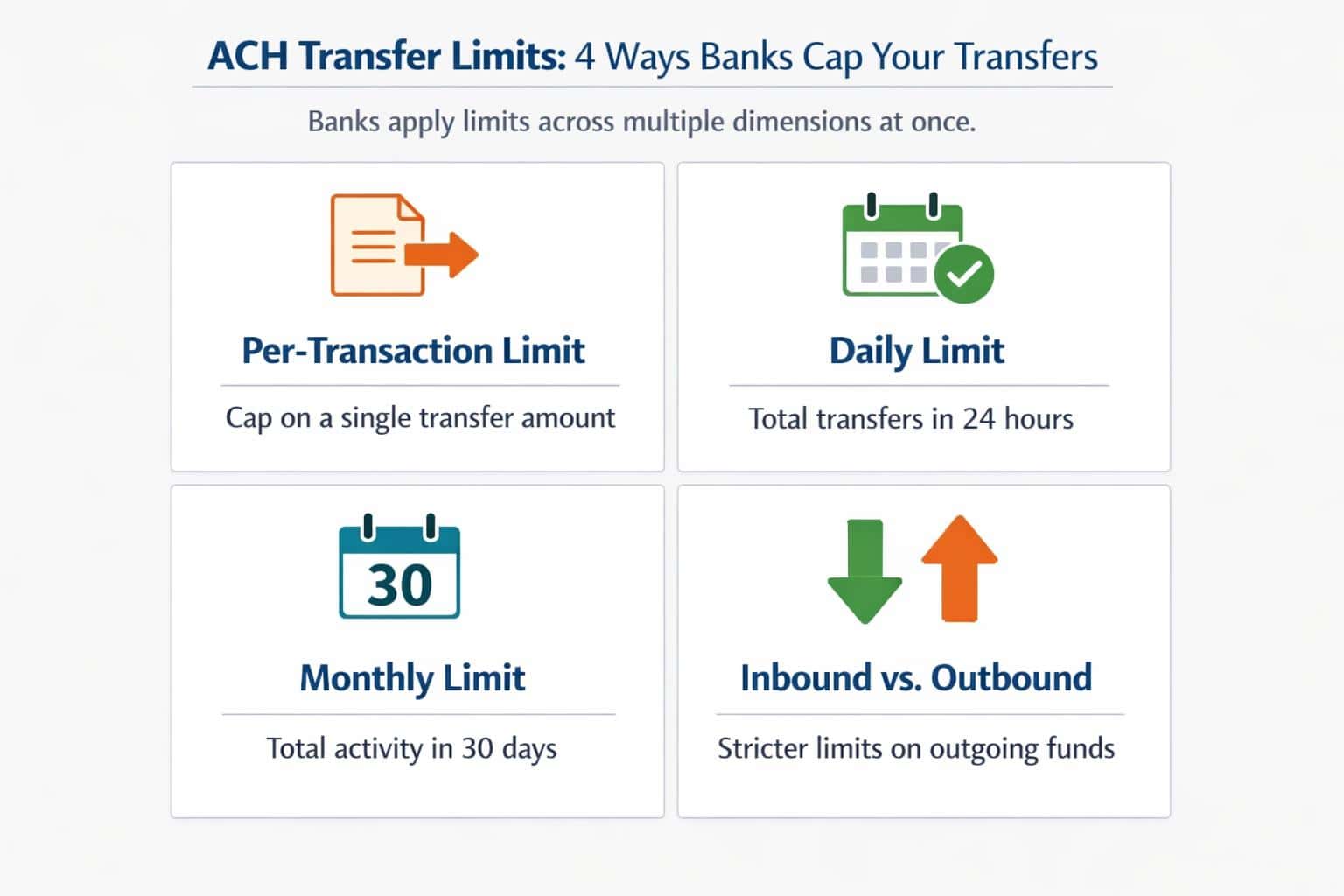
Limits are typically applied across several dimensions at once:
- Per-transaction limits: A cap on how much can be sent in a single transfer.
- Daily limits: A ceiling on the total amount transferred within a 24-hour period, regardless of how many separate transactions you initiate.
- Monthly limits: Some institutions cap total ACH activity over a rolling 30-day period, particularly for outbound transfers.
- Inbound vs. outbound limits: Some banks apply stricter limits on money leaving an account than on money coming in.
A bank might allow you to receive any amount via ACH while restricting outgoing transfers to a daily cap, for example. Understanding both sides of the equation matters when you are coordinating a transfer between two different institutions.
How Same-Day ACH Affects Limits
Nacha has expanded same-day ACH capabilities over the years, allowing eligible transactions to settle within the same business day rather than one to three days. This is faster and often more convenient, but same-day ACH transactions come with their own per-transaction dollar caps set at the network level by Nacha.
Nacha has raised the same-day ACH per-transaction limit several times since the service launched, and the ceiling has increased substantially from its original level. Because this figure is subject to periodic review and adjustment, checking Nacha’s published guidelines or your bank’s current documentation is the most reliable way to confirm what applies today.
If you need to transfer an amount that exceeds the same-day ACH cap, the transaction will typically be processed through the standard ACH timeline instead, unless you use an alternative method such as a wire transfer.
Account History and Relationship Factors
Banks do not always apply the same limit to every customer. Account age, transaction history, account type, and your overall relationship with the institution can all influence the limits on your account.
A brand-new checking account at a bank where you have no prior history may come with lower initial limits. Once you have established a track record of reliable transactions, some banks will increase those limits automatically, while others require you to request a change.
Premium or business account tiers often include higher transfer limits as a feature. If you regularly move larger amounts, it is worth asking your bank whether upgrading your account type or requesting a limit increase is an option. Many banks will accommodate customers with a strong account history, though approval is not guaranteed and the process varies by institution.
What Happens When You Hit a Limit
If you initiate a transfer that exceeds your limit, one of two things typically happens. The transaction may be declined outright, or it may be processed up to the limit with the remainder rejected. Either way, you will usually receive a notification, though the timing and clarity of that notice depends on the bank.
Hitting a limit can create real problems if you are trying to meet a deadline, such as a payment due date or a real estate closing. Planning ahead helps. If you know a large transfer is coming, contacting your bank in advance to ask about temporary limit increases or alternative methods can prevent a last-minute scramble.
Alternatives When ACH Limits Are Too Low
When an ACH transfer cannot accommodate the amount you need to move, there are a few alternatives to consider, each with its own trade-offs:
- Wire transfers: These settle quickly and generally do not carry the same dollar caps as ACH transfers. However, they typically involve fees on both the sending and receiving ends, and they are much harder to reverse than ACH transactions, which can be a risk if an error is made.
- Splitting the transfer over multiple days: If timing allows, breaking a large transfer into smaller amounts spread across several days can work around daily limits. This approach requires planning and may not suit urgent situations.
- Cashier’s checks: For one-time large payments such as a down payment or a vehicle purchase, a cashier’s check is a reliable alternative. It typically involves a fee but is widely accepted and has no ACH-related ceiling.
- Zelle: Some banks have integrated Zelle for person-to-person transfers, which operates outside the standard ACH batch process. Zelle has its own limits set by individual banks, so these vary as well.
Practical Steps for Managing ACH Limits
Getting caught off guard by a transfer limit is more common than it should be, largely because many account holders never look into their limits until they hit one. A few practical steps can help you stay ahead of the issue.
Start by finding out what your current ACH limits actually are. This information is usually available in your bank’s online account settings, its help center, or by calling customer service directly. Keep in mind that limits can change, so information that was accurate a year ago may no longer apply.
If you are moving money between two banks, check the limits at both institutions. The outbound limit at your sending bank and the inbound limit at your receiving bank can both affect the transfer. Knowing which institution is more restrictive helps you plan the logistics correctly.
For large, time-sensitive transfers, starting the process earlier than you think necessary is a sensible approach. ACH processing times are not always predictable, and delays caused by weekends, bank holidays, or compliance holds can add days to a transfer that appeared straightforward when you initiated it.