
How to Start a Longevity Business: Startup Costs, Market Size, and Profit Models


The commercial “longevity now” economy, covering consumer diagnostics, supplements, wellness, and preventive aging services, generated roughly $800 billion globally in 2024 and is projected to approach $1.4 trillion by 2029, growing at an estimated 10–12% CAGR. Unlike capital-intensive biotech longevity research, the most durable and profitable businesses today focus on immediate, out-of-pocket solutions for consumers actively investing in how they age. Entrepreneurs without biotech credentials or venture-scale funding can realistically reach revenue within 12–24 months by prioritizing unit economics, retention, and regulatory-aware positioning.
- “Longevity now” beats “longevity next” for cash flow: Biomarker testing, supplements, digital health platforms, and concierge services generate revenue immediately, while gene therapies and cellular reprogramming require years of capital burn before commercialization.
- Biomarker platforms offer the strongest early economics: Typical gross margins of 60–75% and lifetime values of $800–$1,500 can support CAC recovery within 12 months if churn is controlled through engagement and longitudinal tracking.
- Supplements scale fast but demand retention discipline: DTC longevity supplements can launch with $20k–$50k per SKU and reach 65–80% gross margins, but paid acquisition only works when 18–24 month lifetime value exceeds $300–$600.
- Clinics deliver the highest LTV, highest complexity: Longevity clinics and concierge health services can generate $2,000–$40,000+ per customer but require heavy regulatory, staffing, and real-estate commitments.
- The real moat is trust, not technology: Sustainable longevity businesses win through retention, longitudinal data, clinician credibility, and education, not speculative anti-aging claims or easily replicated products.
The longevity economy, when narrowly defined to include commercial longevity-focused health, wellness, diagnostics, and preventive aging services, generated approximately $800 billion globally in 2024, according to aggregated estimates across healthy aging, diagnostics, supplements, and preventive care markets. Projections suggest this combined segment could approach $1.4 trillion by 2029, implying a compound annual growth rate of roughly 10–12%, depending on category composition.
While billions continue flowing into capital-intensive biotech longevity research, the most consistently profitable longevity businesses are not those pursuing radical life extension. They are the ones addressing immediate, practical needs for customers who are actively investing in how they age. Distinguishing between these two business models is essential to building a sustainable company rather than burning capital on long-horizon scientific bets.
The market is commonly framed as “longevity now” versus “longevity next.” Longevity-now businesses include consumer diagnostics, supplements, health optimization services, and preventive care, generating revenue today from customers paying largely out of pocket. Longevity-next ventures, such as cellular reprogramming, gene therapies, and senolytics, typically require tens of millions of dollars in funding and years of clinical development before commercialization.
This guide focuses on the former category, where entrepreneurs without biotech PhDs or venture-scale capital can realistically build revenue-generating, and in some cases profitable, businesses within a 12- to 24-month timeframe, depending on execution, regulation, and market positioning.
Market Sizing: Where the Real Money Lives
The “complementary and alternative medicine (CAM) for anti-aging and longevity” category was estimated at $77.3 billion in 2024 and is projected to reach $537.6 billion by 2034, implying a 21.5% CAGR based on report-defined market scope. This isn’t speculative biotech, it’s largely herbal products, mind-body interventions, and wellness services that consumers purchase voluntarily, typically out-of-pocket, because they want practical improvements in how they age.
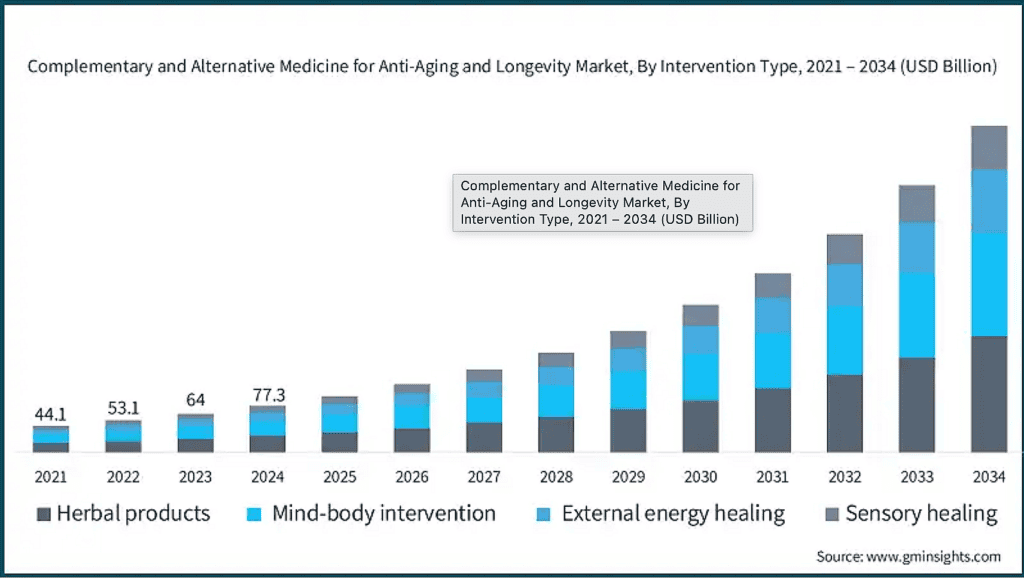
Source: Global Market Insight
Business Model #1: Biomarker Testing and Diagnostics Platform
- Initial capital requirement: $75,000 to $150,000
- Monthly operating expenses: $12,000 to $25,000
- Gross margins: 60% to 75%
- Customer acquisition cost: $150 to $400
- Lifetime value: $800 to $1,500
The biomarker testing model has produced several fast-growing, venture-backed companies reaching large nine-figure valuations within a few years. Function Health charges $499 annually ($42 monthly) for two comprehensive blood panels covering roughly 100 to 160 biomarkers, depending on panel configuration. Superpower offers similar testing at $499 annually, bundling lab work with physician-reviewed insights and AI-enhanced guidance. Higher-end biomarker testing services in the U.S. market charge $1,000 or more for expanded panels, while premium preventative services such as full-body MRI scans command $2,500 to $4,000.
Startup costs typically break down into platform development ($40,000 to $70,000), regulatory compliance and HIPAA infrastructure ($15,000 to $30,000), lab partnerships and initial testing volume commitments ($10,000 to $30,000), and marketing and brand development ($10,000 to $20,000).
The model works because you are not running the laboratories. Instead, established providers such as Quest Diagnosticsand LabCorp handle blood draws and analysis, while the platform focuses on curating which biomarkers matter, translating results into plain language, and providing actionable, longitudinal health guidance.
The path to profitability hinges on retention. If customers remain subscribed for approximately 12 months, acquisition costs can be recovered. If they stay for 24 to 36 months, platforms can generate two to three times return on customer acquisition spend. Public disclosures are limited, but industry reporting suggests that leading platforms have reached large membership bases, implying annual revenue in the tens of millions of dollars with relatively lean, asset-light operations.
The primary challenge is churn. If customers do not see measurable improvements or find the testing and follow-up process cumbersome, cancellation rates increase. Successful platforms address this through continuous engagement, AI-driven personalization, and clear progress tracking over time.
Regulatory considerations remain manageable when platforms position themselves as wellness and health optimization services rather than diagnostic providers. However, when results are interpreted and personalized interventions are suggested, physician involvement is often required. This typically involves employing or contracting licensed providers, adding approximately $5,000 to $15,000 per month in labor costs while increasing credibility and defensibility relative to non-clinical competitors.
Business Model #2: Longevity Supplements and Nutraceuticals
- Initial capital requirement: $20,000 to $75,000
- Monthly operating expenses: $8,000 to $20,000
- Gross margins: 65% to 80%
- Customer acquisition cost: $50 to $150
- Lifetime value: $300 to $600
Longevity Box, a UK-based longevity supplement brand, has reported monthly revenue of approximately £75,000 (around $93,000 USD) with consistent 5%+ month-on-month growth, based on founder statements. The company launched with an estimated $20,000 in initial capital. While these figures are founder-reported rather than independently audited, the model, science-backed supplement formulations marketed to younger demographics, has been replicated by multiple direct-to-consumer supplement founders.
The supplement opportunity splits into two categories:
• Formulation-focused brands creating proprietary compounds inspired by longevity and aging-related research
• Curation-focused brands packaging existing supplements into structured protocols
Formulation-focused brands typically require greater scientific and quality-control rigor (e.g., tighter supplier vetting, stability/COA testing, compliant claims) and can support premium pricing. Longevity-positioned supplements (such as NAD⁺-support and mitochondrial health formulas) commonly sell in the $79 to $149 per month range in subscription DTC models, but claims should be framed carefully around “support” rather than implying clinically proven senescence reversal.
On manufacturing, minimum order quantities (MOQs) vary by format and manufacturer: many capsule/powder runs are often 2,500 to 10,000 units per SKU, while gummies, liquids, and more complex formats can require higher minimums. Initial setup + first inventory is therefore more accurately described as $20,000 to $50,000+ per SKU, depending on formulation complexity, testing requirements, and where you manufacture.
Margins can still be strong: for a supplement retailing at $100 to $150, core product COGS (formula + packaging, before paid acquisition and overhead) often lands around $25 to $45 depending on ingredients and format. But in competitive digital channels, customer acquisition costs can consume a large share of gross profit unless retention and lifetime value are strong enough to offset paid media volatility.
Curation-focused brands aggregate researched supplements into convenient stacks. Customers pay primarily for convenience and guidance rather than proprietary formulations. This model requires less capital, typically $10,000 to $25,000 to launch, but faces increased competition due to ingredient commoditization. Differentiation is driven by brand, educational content, and community rather than unique ingredients.
Under the U.S. Food and Drug Administration’s Dietary Supplement Health and Education Act (DSHEA), brands may make structure/function claims without clinical trials if claims are truthful, not misleading, and supported by scientific substantiation. Companies must include the required DSHEA disclaimer and notify the FDA within 30 days of marketing such claims. Acceptable statements include “supports healthy NAD+ levels” or “promotes cellular energy,” while claims to “reverse aging” or “treat disease” are prohibited. Violations can result in FDA warning letters or enforcement actions. Regulatory consultants typically cost $2,000 to $5,000 initially.
Successful supplement brands invest heavily in educational content, blogs, video, podcasts, and newsletters, to build authority before pushing sales. Customer acquisition costs of $50 to $150 are viable only when lifetime value reaches $300 to $600 over an 18- to 24-month period.
Business Model #3: Longevity Clinics and Concierge Health Services
- Initial capital requirement: $100,000 to $300,000 (physical clinic) or $50,000 to $100,000 (telemedicine-first)
- Monthly operating expenses: $25,000 to $80,000
- Gross margins: 40% to 60%
- Customer lifetime value: $2,000 to $40,000+
The services model generates the highest per-customer revenue but also carries the greatest operational complexity. Ultra-premium offerings such as Equinox’s longevity and health optimization programs represent the top tier, with annual pricing that can approach $40,000 for select cohorts and markets. Telemedicine platforms offering longevity-focused care plans, including physician oversight and supplements, often operate at $40 to $100 monthly before labs and consults. Mid-market clinics typically charge $200 to $500 per month for bundled optimization services that include biomarker tracking, physician consultations, and lifestyle coaching.
Physical clinics require:
• Real estate ($3,000 to $10,000 monthly rent)
• Medical equipment ($20,000 to $100,000 for DEXA scanners, VO2 max testing, CGM programming)
• Licensed physicians and staff ($15,000 to $50,000 monthly)
• Liability insurance ($2,000 to $5,000 monthly)
The upfront investment is substantial but scalable in affluent metropolitan areas, where 200 to 400 active clients can support $1.5 million to $5 million in annual revenue under premium pricing and strong retention assumptions.
Telemedicine-first models reduce fixed costs and physical constraints. Core requirements include physician contractors ($100 to $200 per consult), telehealth platform technology ($5,000 to $15,000 initial setup, $500 to $2,000 monthly), and compliant patient intake and data systems. Revenue per customer is typically lower, $500 to $1,500 annually, but growth potential is higher due to fewer capacity limits.
Regulatory considerations are critical. Physicians must be licensed in each state where patients reside. Off-label prescribing of FDA-approved medications such as metformin or rapamycin is legal but closely scrutinized, particularly in marketing and patient acquisition. NAD+ precursors are regulated as supplements rather than prescription drugs. Legal and compliance support ($5,000 to $20,000 initially) helps mitigate regulatory and enforcement risk.
Corporate wellness represents an additional revenue stream. Employers may allocate $20,000 to $200,000 annually for executive longevity and health optimization programs, providing stable B2B income with longer sales cycles.
Business Model #4: Digital Health Optimization Platform
- Initial capital requirement: $30,000 to $100,000
- Monthly operating expenses: $8,000 to $25,000
- Gross margins: 70% to 85%
- Customer acquisition cost: $75 to $200
- Lifetime value: $400 to $1,000
Digital platforms combine software scalability with personalized guidance. Most early-stage platforms operate as software-first MVPs, while many market examples function as hybrid models that layer services, logistics, or clinic partnerships on top of software. These platforms typically support biomarker booking, habit tracking, wearable data aggregation, and educational guidance rather than regulated medical care.
Development costs range from $30,000 to $100,000 for non-clinical platforms, depending on features and integrations with Apple HealthKit, Google Fit, and consumer wearables. User churn remains the primary challenge: 50% to 70% of health app users disengage within 90 days unless clear, immediate value is delivered.
Successful platforms blend multiple revenue streams:
• Subscription fees ($10 to $50 monthly)
• Affiliate commissions on supplements (10% to 20%)
• Referral revenue from biomarker testing ($50 to $100 per test)
• Premium tiers with human support ($100 to $200 monthly)
Infrastructure scales efficiently, but reaching product–market fit typically requires 12 to 18 months. Six-figure marketing spend ($200,000 to $500,000) applies to post–product-market-fit scaling, not initial validation.
The Path From Idea to Revenue
Most longevity businesses face an early engagement challenge: measurable biological improvements take time, while customers expect near-term feedback. Biomarkers typically shift over months, not weeks. Successful companies maintain motivation by reinforcing short-term wins such as improved sleep, energy levels, strength gains, or consistency streaks.
A common revenue trajectory for consumer-focused longevity businesses is:
-
Months 1–6: High investment with limited revenue, typically $2,000–$10,000 monthly, as product-market fit and acquisition channels are tested.
-
Months 7–12: Revenue grows to $10,000–$40,000 monthly once paid acquisition and onboarding flows stabilize.
-
Months 13–24: Improved retention and upsells can lift revenue to $30,000–$100,000 monthly, depending on churn control.
-
Year 3+: Businesses with sustained retention and efficient CAC commonly generate $500,000 to $3 million annually, though many plateau below this range.
Reaching year three does not guarantee retention is solved, but survival requires at least partial alignment between customer acquisition costs and lifetime value. Businesses that fail typically do so because CAC consistently exceeds LTV, making growth structurally unprofitable.
Competition and Moats
The longevity sector grows more crowded each month. Commoditized businesses, generic supplements and basic biomarker platforms, compete primarily on price and marketing. More durable businesses build moats through proprietary longitudinal data, clinician workflows, trusted education, or engaged communities.
Function Health’s advantage lies in its growing repository of longitudinal lab data collected through recurring testing and user engagement, which can improve personalization over time, though the scale of this dataset has not been publicly disclosed. Superpower differentiates through its concierge-style experience and coordinated access to physicians, which enhances perceived value but remains operationally replicable.
The strongest longevity businesses create switching costs through accumulated health data, embedded habits, and community trust. Contract manufacturers can replicate formulations, and developers can clone software. Over the long term, the most defensible moat is credibility, earned through education, transparency, and consistently delivered results.
The Reality Check
Most longevity startups fail, not because demand is missing, but because founders underestimate customer acquisition costs, overestimate retention, or exhaust capital before reaching profitability. Early-stage supplement brands frequently shut down within the first few years, and many consumer-facing biomarker platforms struggle to scale beyond a small user base.
The opportunity is real, demographic trends virtually guarantee rising interest in longevity solutions. But demand alone does not ensure success. Longevity businesses that endure are the ones focused on disciplined unit economics, strong retention, and solving immediate, tangible problems, not selling speculative promises or distant science.