
The Viral “Retire Early, Live Longer” Chart Is Wrong: Here’s What the Science Actually Says


The viral chart claiming that people who retire at 58 live to 80 while those who retire at 65 die at 66 is not backed by any credible research. Scientific evidence shows no simple, linear link between retirement age and lifespan. Instead, long-term health, job demands, income, and education drive both when people retire and how long they live. When studies adjust for these factors, the dramatic lifespan gaps shown online disappear.
- Retirement age is not a causal predictor of mortality; underlying health and socioeconomic conditions explain most differences in lifespan.
- Early retirees often exit the workforce due to illness or job strain, creating a false appearance that retiring early shortens life.
- People who work longer typically start with better health, safer jobs, higher income, and stronger access to care, not a life-extending effect of working later.
- High-quality studies show mixed or no significant relationship once confounders like health, occupation and income are controlled.
- Longevity is shaped by decades of health behaviors, stress exposure and economic stability, not the specific age at which someone retires.
A graphic circulating on social media claims that people who retire earlier live dramatically longer than those who retire later. One version states that individuals who retire at 58 live to 80, while those who retire at 65 die at 66. It appears authoritative and has spread widely, but its conclusion is not supported by credible scientific evidence.
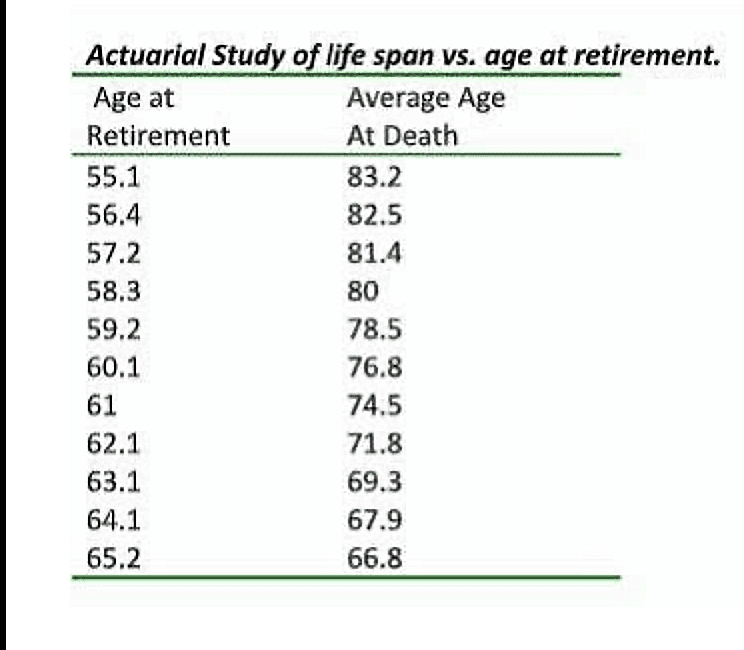
Source: Facebook
Research on retirement and mortality is more complex and does not show a simple, linear relationship like the viral chart suggests. Lifespan varies significantly across populations, and retirement age is strongly influenced by factors such as health, job type, income and education. These same factors also shape mortality outcomes. Because the underlying variables overlap so heavily, it is misleading to treat retirement timing as the cause of a longer or shorter lifespan.
The scientific literature shows mixed findings: some studies find no meaningful association between early retirement and higher mortality, some detect modest benefits for later retirement among healthy workers, and others highlight that pre-existing health conditions, not retirement itself, drive most differences in lifespan. These nuances make it clear that the viral chart oversimplifies a much more complex issue. This article explains why the graphic is inaccurate, what current research actually shows and which factors truly influence longevity.
Why the Viral Chart Is So Misleading
The viral chart circulating online claims that the age you retire directly determines the age you die, a simplistic conclusion that is not supported by any credible research. This is the first major factual error. Retirement age and mortality are influenced by a wide range of variables, including income, education, health status, occupation type, lifestyle, and access to healthcare. No reputable study isolates retirement timing as a sole or dominant causal factor.
The chart also presents impossibly precise numbers: neat clusters of life expectancy tied to specific retirement ages. Real longitudinal research, including nationally representative health and aging studies, shows extensive variation in lifespan even among people who retire at the same age. Individuals in these datasets do not die at uniform ages, nor do mortality patterns form clean, linear trends the way the graphic implies.
Another major red flag is the absence of a source. A legitimate finding of this magnitude would come from organizations conducting large-scale cohort studies, for example, national health agencies or university research centers, and would clearly cite data methodology, sample size, and limitations. The viral chart provides none of that. Without verifiable origins, consistent methodology, or published research behind it, the figures appear to be either fabricated or selectively assembled to create a dramatic but false narrative.
In short, the chart oversimplifies complex health dynamics, misrepresents how mortality data behaves, and offers claims unsupported by any credible evidence.
What Research on Retirement and Mortality Actually Finds
The relationship between retirement age and longevity is widely misunderstood. Viral charts often claim that retiring early helps you live longer or that working longer shortens your lifespan. But the scientific research on retirement and mortality does not support these simplified conclusions. Studies across the United States, Europe, and OECD countries show a far more nuanced reality, especially once health and socioeconomic factors are considered.
The Evidence Is Mixed and Depends on Health and Job Type
Researchers agree on a central point: there is no single, universal rule linking retirement age to mortality. Lifespan is shaped by long-term health, occupation, education, income, and lifestyle choices, all of which influence both when people retire and how long they live.
Because these variables overlap, the connection between retirement timing and longevity is often misinterpreted.
Why Some Studies Show Higher Mortality After Early Retirement
In some datasets, early retirees appear to have higher mortality rates. But deeper analysis shows that this pattern is driven by pre-existing health problems, not early retirement itself.
Many people retire early because of:
-
chronic illness or disability
-
injury or physical strain
-
poor baseline health
-
jobs that are physically demanding
These health factors increase mortality risk regardless of when retirement occurs. This phenomenon is known as the healthy worker effect, a well-documented bias in epidemiological research where healthier individuals remain employed longer while those in poorer health exit the workforce earlier.
Social Security research using U.S. data reinforces this pattern, showing that early retirees often had worse health long before retirement, which influences lifespan more than retirement timing. A detailed example appears in SSA’s retirement and mortality analysis.
Why Working Longer Sometimes Appears to Improve Longevity
Some studies show that individuals who retire later tend to live longer. However, this correlation does not prove that delaying retirement causes better health outcomes.
People who can work longer generally have:
-
better lifetime health
-
less physically demanding jobs
-
higher education levels
-
more stable income
-
stronger access to healthcare and employer benefits
These advantages independently support longevity. Research summarized in the OECD’s health and retirement overview shows that once such factors are controlled, the survival advantage of later retirees becomes small or statistically insignificant.
Similarly, widely cited work on habit formation, such as Wharton’s explanation of the fresh start effect, underscores that people with more stability and resources tend to maintain healthier behaviors throughout their lives, which also influences how long they work.
Many High-Quality Studies Find No Significant Relationship at All
When researchers adjust for:
-
income differences
-
education level
-
occupation type
-
baseline physical and mental health
-
long-term lifestyle patterns
The link between retirement age and mortality often fades or disappears entirely. Systematic reviews and international comparisons, summarized in several OECD longevity and retirement studies, consistently report no strong causal relationship between choosing to retire early or late and the age at which a person dies.
Different countries, pension designs, and job conditions produce different results, reinforcing that there is no universal pattern.
The Real Consensus: Health Drives Retirement More Than Retirement Drives Health
Across the scientific literature, one conclusion stands out clearly:
Poor health tends to cause early retirement, not the other way around.
Likewise, the ability to work into one’s late 60s or 70s reflects lifelong advantages, not a protective effect of working longer.
As a result:
-
Retiring early does not reliably shorten lifespan
-
Retiring later does not reliably extend lifespan
-
Mortality outcomes depend far more on long-term health, job demands, and lifestyle than on the specific retirement age
For readers searching for evidence-based guidance rather than misleading viral charts, this is the most accurate summary of what the research truly shows.
The Key Reasons the Viral Claim Is Wrong
The viral chart linking early retirement to shorter life expectancy oversimplifies a complex issue. Research shows that retirement age cannot be separated from the health, job conditions and socioeconomic factors that shape longevity throughout a person’s life. When these confounders are considered, the dramatic lifespan gaps shown in the graphic disappear.
A major problem is underlying health. Many people retire early due to illness or disability, which naturally increases mortality risk. Others retire early by choice because they are healthier and financially secure. Meanwhile, people who work into their late 60s are typically healthier to begin with. This healthy worker effect makes retirement age a poor standalone indicator of lifespan.
Job type is another critical factor. Workers in physically demanding or high-risk occupations often retire earlier because of the strain their jobs place on the body, and these occupations also correlate with higher mortality regardless of retirement timing. In contrast, office and professional workers face fewer physical hazards and can continue working longer without the same health impact.
Socioeconomic status further undermines the viral claim. Income and education are powerful predictors of longevity. Higher-income individuals can afford to retire earlier and tend to live longer due to better access to healthcare and healthier living conditions. Lower-income individuals may delay retirement out of necessity and generally have shorter life expectancy for reasons unrelated to how long they work.
Once studies adjust for health, occupation and socioeconomic differences, the supposed relationship between early retirement and early death disappears. The viral chart ignores these realities, making its conclusions misleading and unsupported.
What Actually Determines Longevity
Research shows that longevity is shaped far more by lifelong health and socioeconomic conditions than by retirement age. Factors such as smoking, exercise, diet and alcohol use strongly influence long-term health outcomes. Socioeconomic background also matters, affecting education, healthcare access and overall living conditions.
A person’s occupation contributes as well, since physical strain and long-term stress can impact mortality regardless of when someone retires. Quality of healthcare during midlife and genetic or family history further shape lifespan.
Because these factors influence both health and financial stability, they also influence when someone retires. Retirement timing is therefore better understood as a result of long-term conditions, not a primary driver of how long someone lives.
Why Some Early Retirees Do Live Longer
Some people retire in their 50s and still enjoy long, healthy lives, but their longevity reflects their advantages, not the act of retiring early. These individuals typically have strong financial security, consistent access to good healthcare and a history of lower-stress or non-hazardous work.
Their retirement is usually voluntary rather than forced by illness, and they often maintain healthy lifestyle habits throughout adulthood. These factors, rather than the specific retirement age, explain why some early retirees live longer.
Why Some Late Retirees Die Younger
Some people continue working into their mid or late 60s but have shorter lifespans. Again, retirement timing is not the cause. These individuals often include people in:
-
physically demanding jobs
-
financially insecure households
-
environments with high occupational stress
-
situations where early retirement was not financially feasible
The underlying hardships, not delayed retirement, are the drivers of reduced lifespan.
The Real Conclusion: Retirement Does Not Dictate Longevity
Retiring early does not guarantee a longer life, and retiring later does not shorten one. The best available research shows that retirement age is not a causal driver of mortality. The patterns shown in viral, unsourced graphics reflect deeper factors, health status, job conditions and socioeconomic circumstances, that also influence when people retire.
A clearer takeaway is this:
- Your retirement date does not determine how long you live.
- Your lifelong health, work environment and financial realities do.
The viral chart oversimplifies a complex scientific issue, misleading people into believing longevity can be predicted by a single number. Real-world data shows that once confounding factors are accounted for, there is no evidence supporting the chart’s claims.
Final Thought
Choosing when to retire is a personal decision that should be based on health, financial readiness and overall quality of life, not on misleading claims circulating online. The idea that retiring early automatically extends lifespan, or that working longer shortens it, is not supported by credible scientific evidence. Longevity is shaped by decades of health behaviors, job conditions, stress exposure, income levels and access to care. These are the forces that influence both when people retire and how long they ultimately live.
Retirement timing is a reflection of lifelong circumstances, not a predictor of mortality. The viral chart suggests a simple, one-variable explanation for a highly complex outcome, and that simplicity is exactly why it is wrong. Real research shows that no retirement age guarantees a longer or shorter life. What matters most is maintaining long-term health, stability and wellbeing, long before the retirement date arrives.
This article is part of Mooloo’s Retirement & Long-Term Planning Hub, covering retirement income, Social Security decisions, investment risk, healthcare costs, and long-term financial security.