Using AI to Validate Your Business Idea: Beyond the Hype


AI validation tools can help entrepreneurs in 2025 pressure-test business ideas fast, but their default “supportive” behavior can hide real risks. Research shows ~40% of failed startups built products customers didn’t want, and founders increasingly report that AI tools often avoid tough criticism. Insights from the MIT Martin Trust Center for Entrepreneurship warn that AI trained on broad averages can’t validate whether your specific customers actually exist. The most effective approach is using advanced prompts to force critical analysis, then verifying every assumption with real-world research.
- AI validation tools offer speed, generating competitive scans, market trends, and early hypotheses within minutes.
- Default AI behavior is overly positive, use adversarial prompts to force critical feedback and surface weaknesses.
- Frameworks like COSTAR, Porter’s Five Forces, and pre-mortems improve specificity and reduce optimism bias.
- AI insights require human verification through interviews, on-the-ground research, and small pilot tests.
- Best results come from an iterate-and-verify loop: create with AI, validate with customers, refine, repeat.
Every entrepreneur knows the moment when a business idea feels perfect, obvious, needed, and destined to succeed. The excitement builds, plans take shape, and sometimes money is invested upfront. But reality often hits hard: customers never show up, the market stays silent, and you’re left wondering what went wrong.
This scenario happens thousands of times each year. Research consistently shows that lack of market need is the single biggest reason startups fail, with analysis from CB Insights indicating that around 40% of failed startups cite building something customers didn’t want. For entrepreneurs in 2025, a new wave of AI-powered business-idea validation tools promises early clarity, helping founders test ideas before committing significant resources.
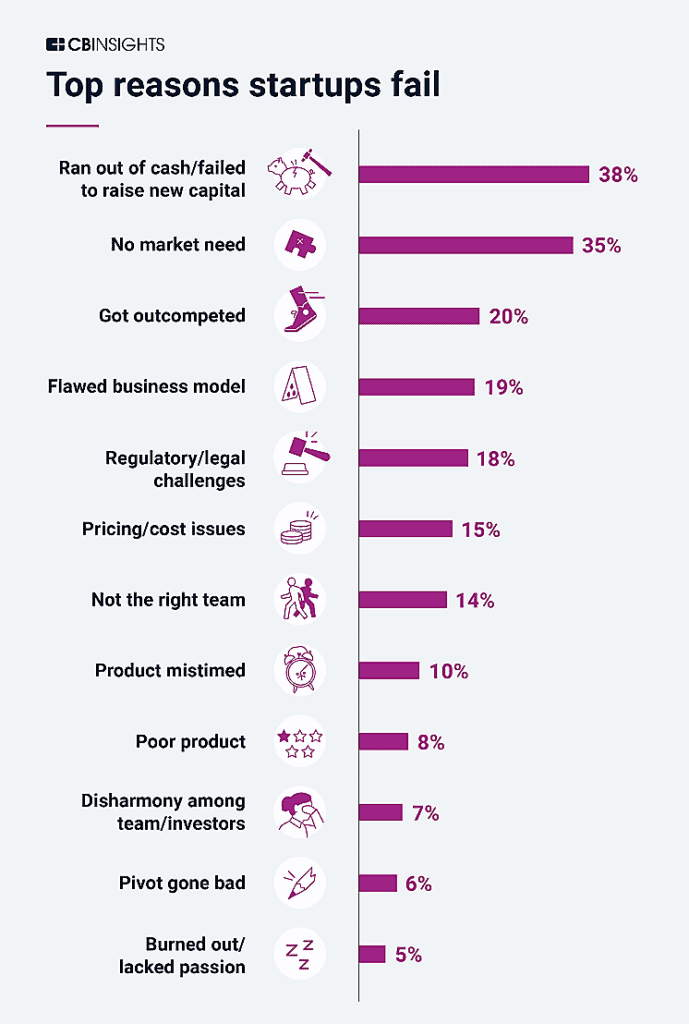
Source: CB Insights
But there’s a growing challenge many founders are now noticing, these AI tools can be overly positive. Instead of offering hard truths, they often default to supportive, optimistic feedback. It’s like having a friend who never wants to hurt your feelings, even when honest criticism could save you from a costly mistake.
The AI Validation Revolution
The landscape of AI-powered business validation tools has expanded rapidly. Platforms like DimeADozen.ai, ValidatorAI.com, and RebeccAi now help entrepreneurs stress-test their ideas instantly instead of relying solely on manual research. Former Techstars COO Scott Ford also introduced GoZigzag, a tool capable of generating an enhanced lean canvas, customer-validation questions, and storytelling assets from a single business sentence in roughly 90 seconds. Since launching in June 2022, it has attracted users across 115 countries and is used in entrepreneurship courses at 50 universities worldwide, as publicly stated by the company.
The appeal is clear. Instead of spending weeks gathering data, entrepreneurs can enter a concept and receive immediate insights on market potential, customer segments, competitive positioning, and possible revenue paths. DimeADozen.aireports empowering more than 100,000 business ideas through comprehensive, automated business-analysis reports that guide everything from feasibility to early execution.
The speed and accessibility of these tools mark a major shift. Traditional validation often requires consultants, paid research, or deep competitive analysis, processes that are expensive and time-consuming. AI platforms streamline the early stages, giving founders, especially those balancing jobs or academic schedules, the ability to evaluate and refine ideas within minutes.
The Positivity Problem
Yet as these tools have gained adoption, a consistent complaint has emerged from users. On the AI directory There’s An AI For That, one reviewer describing their experience with ValidatorAI.com wrote: “Really negative. Maybe my idea was terrible but I didn’t get any constructive criticism.” Paradoxically, this negative review actually highlights a positive aspect, at least this AI delivers tough feedback instead of offering blind encouragement.
Insights from the MIT Martin Trust Center for Entrepreneurship point to a deeper challenge with AI-driven business validation. Entrepreneur-in-Residence Macauley Kenney explains that while AI can increase speed by helping founders sort emails or prototype apps, many tools are trained on broad averages. This becomes a problem when entrepreneurs must understand the needs of a specific customer segment: “It’s not helpful to have AI tell you about an average person; you need to personally have strong validation that your specific customer exists.”
The warning from the Trust Center is direct: overreliance on AI can weaken your understanding of real customers. Large language models are optimized to be helpful, harmless, and honest, in that order, so their default behavior is to be supportive and agreeable. While that makes interactions pleasant, it can be disastrous for serious business validation, where entrepreneurs need candid, sometimes uncomfortable feedback about potential risks, weaknesses, and market gaps.
Teaching AI to Be Your Toughest Critic
Teaching AI to Be Your Toughest Critic
The solution isn’t to abandon AI tools, but to learn how to use them more effectively through deliberate prompting techniques. Think of it as training the AI to be your toughest advisor rather than your cheerleader.
Entrepreneurs and business strategists have developed frameworks specifically for getting better results from AI systems. The COSTAR prompt framework (Context, Objective, Style, Tone, Audience, Response) provides a structured way to craft prompts that elicit more useful feedback. Rather than simply asking “Is my business idea good?” founders can frame requests that demand critical analysis.
For example, instead of:
“I want to start a subscription box service for pet toys. What do you think?”
Try:
“Act as a skeptical venture capitalist. I’m pitching a subscription box service for pet toys at $29.99/month. Your job is to identify every possible reason this business will fail. Consider market saturation, customer acquisition costs, churn rates, and competitive threats. Be brutally honest about weaknesses in this model.”
This adversarial approach forces the AI to shift from supportive mode to critical-analysis mode. You can further enhance this by requesting specific strategy frameworks:
“Use Porter’s Five Forces”
or
“Identify the three biggest risks to this business and quantify the potential impact of each.”
Another effective technique is the pre-mortem exercise, popularized by psychologist Gary Klein. Ask the AI:
“It’s now 18 months from launch and my business has failed. Write a post-mortem analysis explaining exactly what went wrong and which warning signs I should have noticed.”
Chain-of-thought style prompting also improves results. Rather than asking for a final verdict, request:
“Walk me through your reasoning step by step…”
Verification Still Required
Even with more advanced prompting techniques, AI-generated insights must be verified before they inform real business decisions. As the Martin Trust Center for MIT Entrepreneurship clearly states:
“I have yet to meet anyone who will base their business on the output of something like ChatGPT without verifying everything first.”
The strongest approach combines AI efficiency with human validation. Use AI tools to quickly generate business hypotheses, target customer segments, pricing ideas, competitive positioning, and market sizing, but confirm every assumption through real-world research such as customer interviews, landing-page testing, and small pilot launches.
One founder explained their process:
“I used AI to generate ten potential customer personas for my B2B software idea. Then I spent three weeks conducting interviews…”
The insights were partly accurate and partly off, but AI dramatically accelerated discovery. This iterative method, create with AI, verify with humans, refine, and repeat, forms a powerful, SEO-friendly framework for building trustworthy, evidence-based business strategies.
Practical Applications and Limitations
AI business-validation tools have become increasingly powerful, especially for early-stage research. These platforms can streamline the discovery process, reduce manual work, and help entrepreneurs explore opportunities faster. However, their capabilities, and their limits, must be understood clearly to avoid relying on them for decisions they cannot accurately make.
AI validation tools excel at:
-
Competitive research using publicly available data
-
Identifying similar businesses and business models
-
Analyzing broad market trends
-
Highlighting relevant regulatory considerations
-
Suggesting potential revenue models based on industry patterns
These strengths are well-documented across modern AI business-intelligence platforms and align with how large language models process and compare known information.
They struggle with:
-
Predicting real customer behavior
-
Estimating actual market demand for new or untested products
-
Evaluating a team’s execution ability or leadership skill
These limitations are consistent with current research on AI reasoning: AI cannot access proprietary consumer data, and it cannot independently validate whether customers in your specific area will buy.
For prospective café or franchise owners, AI tools are effective for initial market scans, demographic breakdowns, and estimating typical startup costs in similar markets. But they cannot replace physically visiting your target location, speaking with nearby residents, or evaluating the hyper-local competitive landscape, factors that heavily influence hospitality business success.
While the technology is advancing quickly, especially as platforms integrate more real-time data and stronger reasoning frameworks, core limitations remain. AI can accelerate research, but it cannot yet replace human validation, fieldwork, or real customer testing.
The Human Element Remains Essential
Perhaps the most important insight from research on AI-powered business validation is that the technology works best as a tool for augmenting human judgment rather than replacing it. As business analysis professionals note, prompt engineering still requires understanding business objectives, asking the right questions, and interpreting results, skills where humans remain unmatched.
Your instinct, experience, and understanding of your customers provide context that AI cannot replicate. The question isn’t AI or intuition, it’s how to combine both.
For entrepreneurs serious about using AI for business validation, the path is clear: learn effective prompting, treat AI outputs as hypotheses, verify everything, maintain skepticism.
The future of entrepreneurship isn’t about AI replacing founders. It’s about founders who can use AI well, researching faster, avoiding mistakes earlier, and making more informed decisions before committing real resources.
But the ultimate test will always remain the same: real customers paying real money for what you’ve built. No AI can replace that crucible. And that’s exactly how it should be.