
The 2026 Social Security Change: What the New Retirement Age Means for Your Benefits


The final shift to a 67 full retirement age (FRA) arrives in 2026 for everyone born in 1960 or later, completing the schedule set by the 1983 Social Security Amendments. This change creates real differences in when Americans can claim full benefits, how much they receive over a lifetime, and how they plan around Medicare at 65 versus Social Security at 67.
- FRA rises fully to 67 for all born in 1960+, ending the multi-decade increase from age 65 and reshaping when full benefits begin.
- Two-month gap matters: A 1959 birth year has an FRA of 66 & 10 months, meaning 1960 births lose two months of full benefits unless claiming early.
- Early claiming hits harder: Filing at 62 when your FRA is 67 triggers about a 30% permanent reduction under Social Security rules.
- Most retirees stop working early: Surveys from the Employee Benefit Research Institute show many retire around 62 due to health or job loss.
- Retirement planning must bridge the gap between Medicare at 65 and full Social Security at 67, requiring savings or delayed filing strategies.
For decades, the promise of Social Security at age 65 represented a clear milestone in American retirement planning. Workers understood when they could expect full benefits, and that certainty helped shape career decisions, savings strategies, and long-term financial planning. But beginning in 2026, the long-standing age marker will complete its multi-decade shift away from 65 and settle permanently at 67 for most Americans. This change, rooted in legislation passed in 1983 Social Security Amendments, carries significant financial implications today, especially for people now approaching retirement.
The 2026 adjustment reflects the final stage of a gradual schedule that began more than 40 years ago. Under Social Security rules, people born in 1960 or later have a full retirement age of 67, while those born in 1959 face an FRA of 66 and 10 months, a small but meaningful difference for workers planning when to claim benefits. Although the increase was set decades ago, its real-world impact is only now being felt by individuals making critical retirement decisions. Understanding what is changing, why it was implemented, and what claiming options exist can help you navigate the transition more effectively.
What’s Actually Changing in 2026
The Social Security Administration defines full retirement age as the age at which you can claim 100 percent of the monthly benefit you’ve earned based on your working history, according to the Social Security Administration. For decades, this age was 65 for people born in 1937 or earlier, but reforms enacted through the Social Security Amendments of 1983 began gradually increasing it to strengthen the program’s long-term finances. The adjustment rolled out slowly, giving workers many years of notice.
For those born between 1938 and 1959, the full retirement age increased in small steps, typically two months per year of birth. Someone born in 1955 has a full retirement age of 66 and two months, while someone born in 1958 faces 66 and eight months, according to the SSA full retirement age chart. In 2025, individuals born in 1959 reach their full retirement age of 66 years and 10 months.
The 2026 change marks the completion of this multi-decade schedule. Anyone born in 1960 or later now has a full retirement age of 67, confirmed by the SSA full retirement age table. This means someone born in January 1960 will turn 66 in 2026 but won’t reach full retirement age until January 2027, when they turn 67. This shift represents the first move from the 66-and-incremental-months structure to a full 67-year age bracket.
Importantly, this is the final scheduled increase unless Congress passes new legislation. For everyone born in 1960 or afterward, including all of Generation X, Millennials, and Gen Z, the full retirement age is permanently set at 67, a standard reinforced by the Social Security Administration retirement planner, offering long-term planning clarity even as it requires a later age to receive full benefits.
The Real-World Impact: More Than Just One Year
For someone born in 1959 versus 1960, the difference may look small, just a two-month increase in the full retirement age. But this still carries meaningful consequences. A person born in 1960 must wait until age 67, compared with 66 and 10 months for someone born in 1959. This creates a real delay in when full benefits begin and affects both finances and planning.
First, there’s the direct financial impact of receiving benefits later. If your full retirement age benefit is $2,000 per month, being born in 1960 instead of 1959 means losing two months of full benefits, or $4,000, if you wait until your FRA. And if health issues, layoffs, or other challenges force you to claim early, the lifetime reduction is larger under the early-retirement reduction rules because you are claiming further away from the age at which full benefits apply.
Second, the change effectively reduces total lifetime benefits, even though the monthly formula stays the same. Delaying FRA reduces the period during which someone collects full payments. Someone who lives to age 85 will receive two fewer months of full benefits compared with someone born in 1959, about $4,000 less for a person with a $2,000 monthly benefit. Over the broader two-year FRA shift from 65 to 67, the reduction can equal a full year of benefits, which reflects how the benefit calculation formula interacts with a higher full retirement age.
Third, the shift complicates retirement planning for people who long assumed they could retire at 65 or 66. Many Americans structure decisions around familiar milestones, such as Medicare eligibility at 65, only to learn that full Social Security benefits will not begin until 67. This can force difficult choices, including working longer, accepting a reduced benefit by claiming early, or relying more heavily on savings to bridge the gap.
The Gap Between Plans and Reality
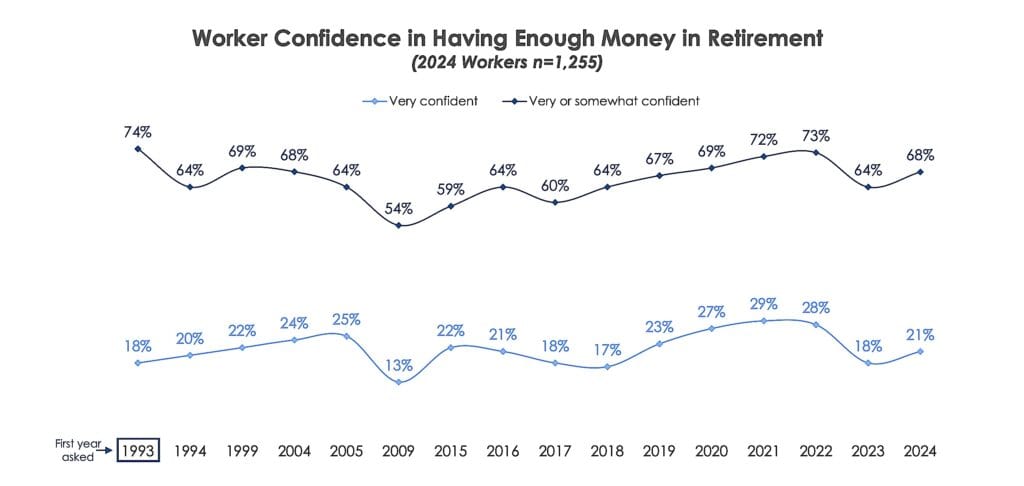
The increase to a full retirement age of 67 highlights the long-standing gap between how Americans plan for retirement and how their lives actually unfold. Research from the Employee Benefit Research Institute shows that although many workers expect to work into their mid-to-late 60s, the median retirement age remains 62, mostly because circumstances force people out sooner than expected.
Nearly 60 percent of retirees say they left work earlier than planned, according to the Retirement Confidence Survey, often due to health issues or job loss. When someone must stop working at 63, 64, or 65 but full Social Security benefits don’t begin until 67, the financial pressure becomes immediate.
Source: Greenwald research
This also explains why about 44 percent of Americans expect to claim Social Security early. Under the Social Security Administration rules, claiming at 62 when your full retirement age is 67 results in about a 30 percent permanent reduction. A $2,000 full benefit becomes roughly $1,400 for life.
Whether early filing makes sense depends on personal needs. It may be appropriate if you need income now, face health concerns, or prefer guaranteed payments sooner. Others point out that Social Security offers inflation-adjusted lifetime income, and the reduction from early claiming can weaken long-term financial security, especially for women, who tend to live longer.
Why Did This Change Happen?
Understanding why Congress increased the full retirement age in 1983 helps explain today’s Social Security debates. In the early 1980s, the program faced a major funding crisis: it was paying more in benefits than it collected in payroll taxes, and the trust fund was projected to run out within months. Bipartisan reforms under President Reagan addressed this shortfall by accelerating payroll tax increases, taxing a portion of benefits for higher-income retirees, and gradually raising the full retirement age.
The age increase reflected demographic realities. When Social Security was created in 1935, the retirement age of 65 was set at a time when life expectancy at birth was about 60, even though those reaching 65 typically lived another 12–15 years. By the 1980s, Americans were living significantly longer, meaning the program was paying benefits for many more years than originally anticipated. Moving the full retirement age to 67 was intended to account for longer lifespans without abruptly reducing benefits for those nearing retirement.
The long phase-in period, from births in 1938 through 1960, gave workers decades to adjust. Because this increase unfolded gradually over more than 40 years, the shift reaching its final step in 2026 is not a new change, but the completion of a long-planned transition.
What Options Do You Have?
If you’re affected by the age-67 full retirement age, understanding your claiming choices helps you make decisions that fit your situation. You can claim Social Security retirement benefits as early as age 62, but doing so permanently reduces your monthly payments. The size of the reduction depends on how many months early you claim. For those with a full retirement age of 67, claiming at 62 reduces the benefit by about 30 percent, while claiming at 65 lowers it by roughly 13.3 percent.
For a full overview of Social Security benefits, rules, and common questions, see our Social Security Explained guide.