
The Most Popular ETF Types: Where Investors Are Putting Their Money


ETF assets remain highly concentrated in 2024–2025, with roughly 20% of funds capturing about 80% of all investor capital, a pattern validated by European regulators and consistent with long-term industry data. Today’s inflows overwhelmingly favor broad U.S. equity, international, and core bond ETFs because they offer low expenses, high liquidity, and transparent index tracking from major issuers like Vanguard, iShares, and SPDR. For investors asking how to build a diversified portfolio using ETFs without overpaying or unintentionally concentrating holdings, the key is starting with broad-market exposure, then adding global equities, bonds, and small satellite positions only where they fit long-term goals.
- Most ETF assets concentrate in large, diversified funds such as the Vanguard S&P 500 ETF and total-market ETFs with expenses near 0.03%.
- International funds like VEA, EFA, VWO, and IEMG remain essential for global diversification even though their AUM is smaller than U.S. equity giants.
- Bond ETFs including AGG and BND provide stability, income, and risk reduction during equity volatility.
- Large sector ETFs such as QQQ, VGT, XLV, XLF, and VNQ offer targeted tilts but should function as satellite positions around core holdings.
- To avoid unintended concentration, investors should review overlapping mega-cap exposures across their broad and sector ETFs.
For investors building portfolios today, understanding where the largest flows of money go is essential. Industry and regulatory analyses show that ETF assets are highly concentrated, with a relatively small share of funds capturing most of the total market. One European regulatory review, for example, found that about 20% of ETFs held roughly 80% of all assets, a pattern consistent with the broader “80/20 rule” seen in financial markets. In this article, we validate this concentration trend, outline the major ETF categories, explain why certain funds dominate, and offer practical insights for beginning to intermediate investors.
The 80/20 Rule in ETF Investing
The concentration of assets in ETFs is unmistakable. The Vanguard S&P 500 ETF (VOO), one of the largest funds in the market, manages over $400 billion in assets, according to Vanguard’s official fund page. Meanwhile, S&P 500–tracking ETFs collectively have expanded from about $90 billion in 2010 to more than $1.8 trillion today, based on industry data compiled by Nasdaq.
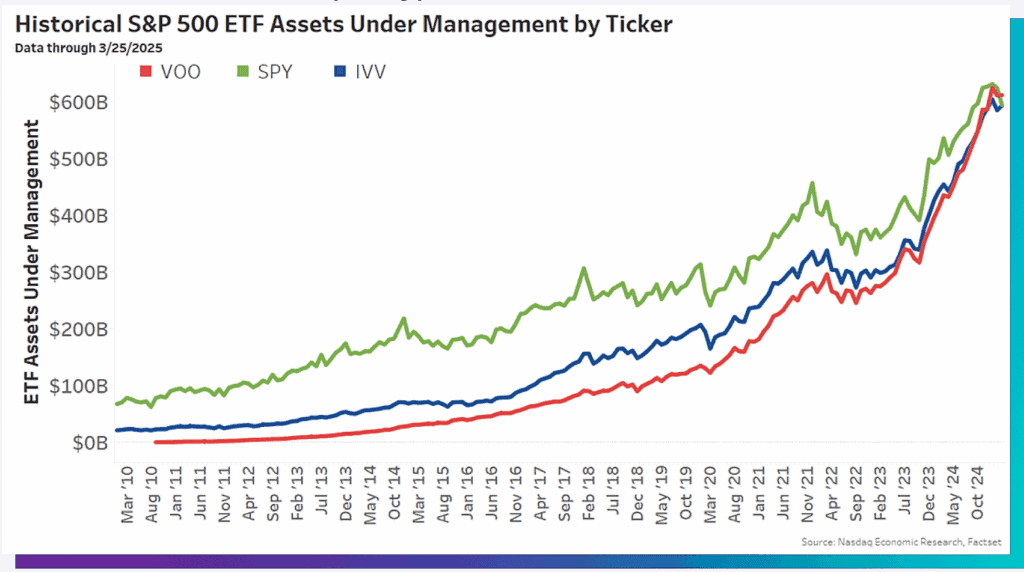
Source: Nasdaq
Together, these figures highlight how a relatively small group of broad-market ETFs captures the majority of investor capital. The takeaway for investors is clear: the most popular ETFs aren’t niche thematic products, they are large, diversified, highly liquid, and cost-efficient vehicles that dominate the market.
Broad Market Index ETFs
At the core of many portfolios are broad market index ETFs. These tend to be the largest by AUM and dominate inflows and holdings.
- The Vanguard S&P 500 ETF (VOO), approximately $800 billion in AUM, remains one of the largest funds in the market.
- The S&P 500 ETF segment as a whole has grown into the multi-trillion-dollar range.
- ETFs that track total U.S. stock market indexes, such as the Vanguard Total Stock Market ETF (VTI), form another large category of core holdings.
These funds dominate because they offer wide market exposure, low expense ratios (some as low as ~0.03%), and high liquidity, all qualities that appeal to long-term investors building the core of their portfolios.
International/Global Equity ETFs
Beyond U.S. equity exposure, many investors allocate to developed and emerging markets through ETFs that support global diversification.
Developed-market funds such as the Vanguard FTSE Developed Markets ETF (VEA) and the iShares MSCI EAFE ETF (EFA) each manage tens of billions of dollars in assets, making them among the largest international ETFs available to U.S. investors.
On the emerging-markets side, the Vanguard FTSE Emerging Markets ETF (VWO) and the iShares Core MSCI Emerging Markets ETF (IEMG) also command substantial AUM. These funds provide exposure to high-growth regions across Asia, Latin America, the Middle East, and other developing economies.
While their asset sizes are generally smaller than the largest U.S. equity ETFs, these international and emerging-market categories remain essential tools for building portfolios that extend diversification beyond domestic markets.
Bond ETFs
Fixed income ETFs also manage substantial assets and play a central role in portfolio diversification. Two of the largest and most widely used bond-market ETFs are the iShares Core U.S. Aggregate Bond ETF (AGG)and the Vanguard Total Bond Market ETF (BND). Both provide broad exposure to the U.S. investment-grade bond market.
These aggregate bond funds include U.S. Treasuries, agency bonds, corporate bonds, and securitized assets, giving investors comprehensive fixed income coverage in a single product.
Bond ETFs serve a distinctly different purpose than equity-focused funds. They help balance overall portfolio risk, reduce volatility, and generate income, benefits that become especially valuable during periods of equity market stress or downturns.
Sector-Specific Popular ETFs
Beyond broad market exposure, many investors use large sector-specific ETFs to tilt their portfolios toward industries they expect to outperform. Technology exposure is often built through the Invesco QQQ Trust (QQQ), one of the most heavily traded ETFs with substantial AUM.
Another major option in the tech space is the Vanguard Information Technology ETF (VGT), which offers pure-play exposure to the information technology sector. In healthcare, investors frequently turn to the Health Care Select Sector SPDR Fund (XLV), a widely used benchmark for the sector.
Financial sector exposure is commonly accessed through the Financial Select Sector SPDR Fund (XLF), which tracks leading U.S. financial institutions. For real estate, the Vanguard Real Estate ETF (VNQ) remains one of the largest and most liquid REIT-focused ETFs.
Because these sector ETFs are large and highly liquid, they are used by both retail and institutional investors seeking targeted industry exposure while still benefiting from strong execution, transparency, and cost efficiency.
Precious Metals & Commodities
Commodity and precious-metals ETFs also attract significant investor interest, though their asset bases are generally smaller than broad equity funds.
Gold exposure is commonly accessed through SPDR Gold Shares (GLD), one of the largest and most liquid gold-backed ETFs globally. For silver, many investors use the iShares Silver Trust (SLV), which offers direct exposure to the metal’s price movements.
Broad commodity ETFs, although more modest in total assets, function as important tools for hedging and diversification. They can help investors manage inflation risk and reduce portfolio correlation during periods when traditional equities and bonds move together.
Growth vs Value
Investors frequently distinguish between growth-oriented and value-oriented strategies, and ETFs offer clear pathways to each approach. Growth-focused ETFs such as the Vanguard Growth ETF (VUG) typically hold large-cap companies with strong earnings momentum and long-term expansion potential.
Value-focused ETFs like the Vanguard Value ETF (VTV) emphasize companies with lower price-to-earnings ratios, durable cash flows, and more defensive characteristics.
Market capitalization also shapes investor outcomes. Large-cap, mid-cap, and small-cap ETFs each offer different mixes of risk and return, enabling investors to tailor their portfolios to their goals, time horizon, and volatility tolerance.
Specialized Categories
Beyond core and sector-focused products, several specialized ETF categories continue to grow in popularity. Dividend-oriented funds, such as the Vanguard High Dividend Yield ETF (VYM) and the iShares Select Dividend ETF (DVY), help investors prioritize income generation and stability over pure growth.
ESG-focused ETFs, including the iShares ESG Aware MSCI USA ETF (ESGU), appeal to investors who want portfolios aligned with environmental, social, and governance considerations.
Thematic ETFs capture long-term trends such as artificial intelligence, clean energy, or biotechnology. Examples include the Global X Robotics & Artificial Intelligence ETF (BOTZ) and the iShares Global Clean Energy ETF (ICLN). While these products typically have smaller AUM than broad index funds, they continue to attract attention from investors seeking targeted exposure to emerging innovation themes.
Why These ETFs Dominate
Several consistent themes explain why the ETFs mentioned above attract the bulk of industry assets and remain central to investor portfolios:
Lowest expense ratios: Large ETF issuers keep fees extremely low, and lower costs improve long-term returns because fees compound against performance over time.
Highest liquidity: Major ETFs typically offer tight bid–ask spreads and substantial trading volume. This liquidity benefits both retail investors and institutions that need efficient execution.
Institutional adoption: Pension funds, endowments, financial advisors, and model-portfolio platforms frequently use the largest ETFs. Their participation drives asset growth and supports lower operating costs.
Index-tracking reliability: Many leading ETFs follow broad, transparent benchmarks with long histories. Their track records and tracking accuracy help investors trust the consistency of performance.
Brand recognition: Major ETF providers, Vanguard, BlackRock’s iShares, and State Street’s SPDR, dominate the industry due to scale, reputation, and investor confidence. Their brand strength reinforces asset concentration across their flagship products.
Practical Takeaways for Investors
For beginning to intermediate investors aiming to use ETFs effectively, several core principles can help build a balanced and intentional portfolio.
Start with the core: A broad-market ETF such as VOO or VTI offers foundational exposure to the U.S. large-cap and total-stock-market segments, which command the majority of ETF assets and investor inflows.
Layer in global exposure: Adding developed and emerging-markets ETFs helps prevent a portfolio from becoming overly U.S.-centric and improves diversification across different economic regions.
Include bonds for balance: Bond ETFs provide stability, reduce volatility, and generate income, an essential counterweight to equities, even when stock-focused funds dominate asset size.
Use sector or thematic ETFs cautiously: Sector and thematic products can be compelling but generally involve higher risk and narrower focus. Treat them as satellite positions around a core portfolio rather than primary holdings.
Check cost and liquidity: Expense ratios, average spreads, and trading volume still matter. A seemingly small cost difference (such as 0.10%) compounds significantly over long investment horizons.
Be aware of concentration: Because the largest ETFs often hold many of the same mega-cap names, it’s easy to unintentionally duplicate exposure. Review underlying holdings to ensure your portfolio isn’t more concentrated than intended.
Closing Thoughts
The ETF landscape contains thousands of products, yet the majority of investor capital flows into a relatively small group of funds. Understanding which ETFs dominate, why they attract the most assets, and how they align with your investment goals can help you make more informed decisions in an otherwise crowded marketplace.
By prioritizing cost-efficient, highly liquid, and well-established funds, you position your portfolio alongside the largest and most stable market flows. This approach helps avoid unnecessary risks tied to niche products with higher fees or limited liquidity. Ultimately, choosing where your investment dollars go matters, not just for long-term returns, but for maintaining stability, flexibility, and alignment with your broader financial objectives.