
How to Get a Bachelor’s Degree for $50,000 Less: The Community College Transfer Path Explained


With U.S. student loan debt exceeding \$1.8 trillion, the 2+2 model, spending two years at a community college before transferring to a four-year university, remains one of the simplest, most overlooked ways to earn the same bachelor’s degree for tens of thousands less. By completing general education credits at a lower-cost institution first, students can save between \$40,000 and \$70,000 compared with attending a university all four years, while still graduating from the same accredited institution. According to the College Board’s 2024 Trends in College Pricing, average annual tuition is roughly \$4,000 at community colleges versus \$11,260 at public universities and over \$41,000 at private schools.
- Cost Savings: Completing two years at a community college before transferring can reduce total degree expenses by 40–60%, or \$50,000+ for many students.
- Transfer Planning: Check articulation agreements and course equivalency guides early, most require a GPA of 2.5–3.0 to guarantee credit transfer.
- State Programs: Systems like California’s Associate Degree for Transfer (ADT) and Florida’s statewide 2+2 agreement ensure smoother transitions and predictable costs.
- Best for: Majors with flexible prerequisites (business, psychology, computer science) and families seeking to stay within federal loan limits.
- Tradeoffs: Selective universities may limit transfer admission, and some majors (engineering, nursing) require sequenced courses that extend graduation timelines.
With U.S. student loan debt now exceeding $1.8 trillion, and the average bachelor’s degree graduate carrying roughly $30,000 in debt, families are seeking smarter ways to make higher education affordable. One of the most effective yet often overlooked options is the “2+2” approach, spending two years at a community college before transferring to a four-year university.
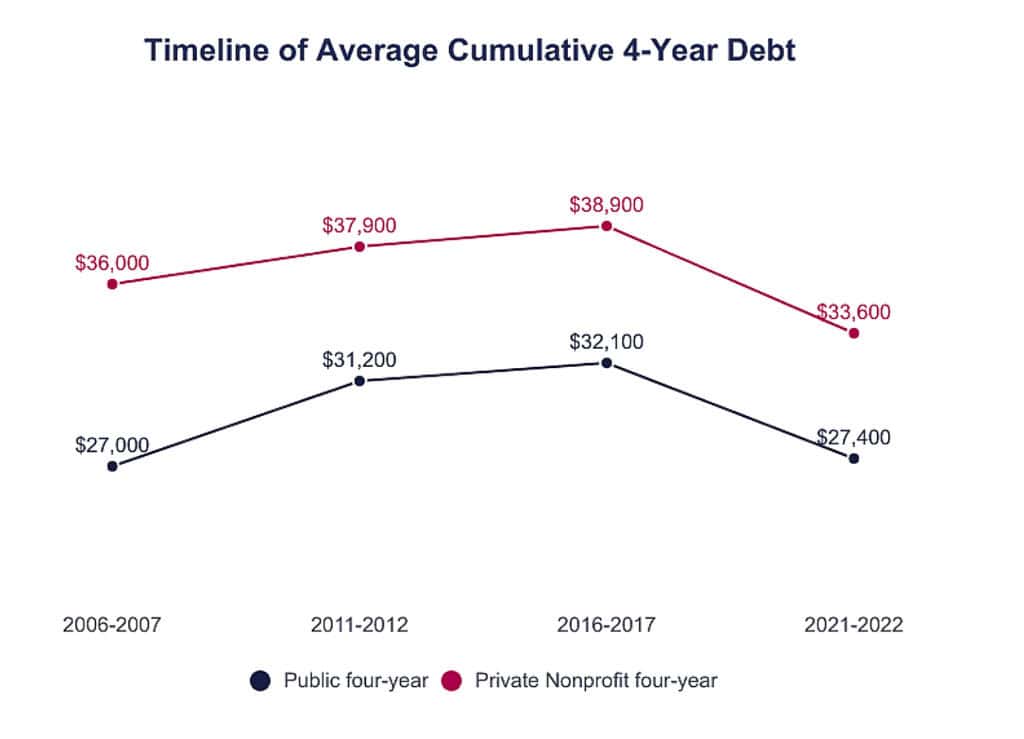
Source: Education Data
The math supports the strategy. A student attending a public four-year university may spend between $100,000 and $120,000 to complete a degree, while a student following the community college route can often finish for $30,000 to $50,000 total. That’s a potential savings of $50,000 or more, achieved simply by completing general education courses at a lower-cost institution before transferring to earn the same bachelor’s credential.
How the 2+2 Model Works
The concept is simple. Students complete their first two years at a community college fulfilling general education and introductory major requirements. After earning an associate degree, they transfer to a four-year university as juniors to finish their bachelor’s degree.
The financial benefit lies in the cost difference between institutions. According to the College Board’s Trends in College Pricing 2024, average annual tuition and fees at community colleges are about $4,000, compared with $11,260 for public four-year universities and more than $41,000 at private institutions. By replacing two years of higher university tuition with lower-cost community college credits, students can cut their total undergraduate expenses by roughly 40% to 60%, depending on where they study and live.
Importantly, the diploma lists only the four-year university’s name, there’s no distinction between students who started as freshmen and those who transferred as juniors, though credit transfer policies and major requirements should be reviewed in advance to ensure a smooth path to graduation.
Making the Transfer Seamless
The key to success is planning ahead. Most community colleges have articulation agreements with nearby public universities that guarantee credit transfer for students who maintain a minimum GPA, typically between 2.5 and 3.0. These agreements specify which courses transfer and how they meet degree requirements at the receiving institution.
Before enrolling in any community college course, students should review the **transfer policies ** of their target universities and intended majors. Many state university systems publish detailed transfer guides that outline course-by-course equivalencies. Meeting with advisors at both the community college and the university helps prevent costly mistakes.
Some states make the process even smoother through statewide transfer pathways. For example, California’s Associate Degree for Transfer (ADT) program guarantees admission to participating California State University (CSU)campuses for students who complete an approved transfer pathway. Florida operates a statewide 2+2 articulation agreement between its community college and university systems, while Texas offers similar coordinated transfer frameworks. These systems make earning a four-year degree more affordable and predictable for students who start at community colleges.
The Real-World Savings
Let’s look at a realistic example. A California student could spend two years at a community college at roughly $1,500 per year in tuition and fees, according to the California Community Colleges Chancellor’s Office. That totals about $3,000. They then transfer to the University of California, Berkeley for two years, where in-state tuition and fees average $16,347 per year, or about $32,700 total. Their complete bachelor’s degree would cost roughly $36,000 in tuition and fees.
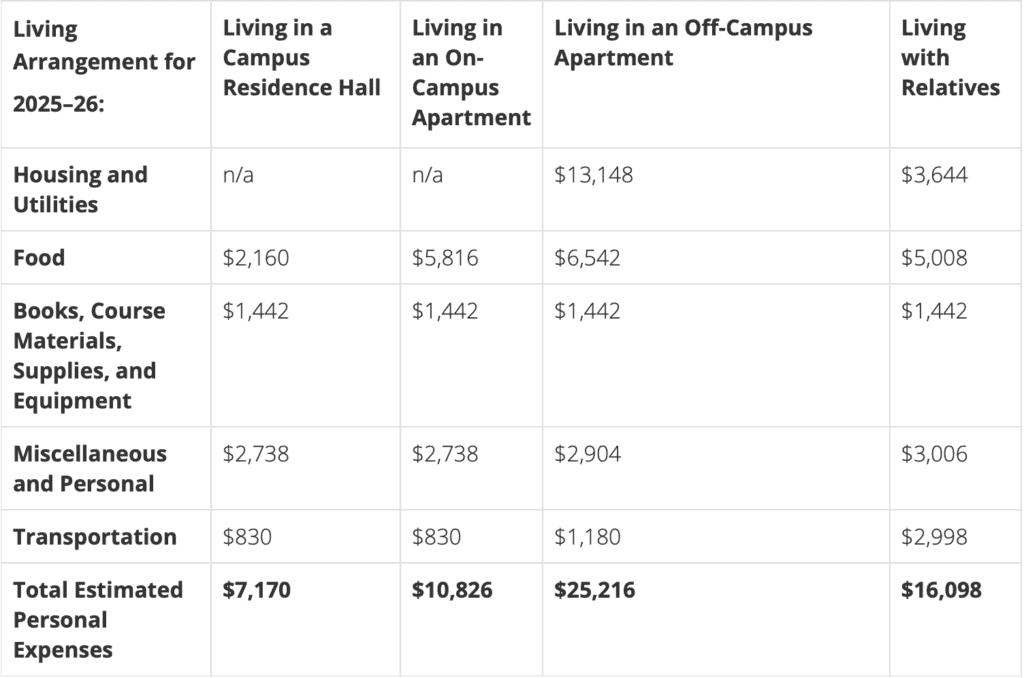
Source: US Berkeley
By comparison, a student who attends UC Berkeley for all four years would pay around $65,000 in tuition and fees alone, before factoring in housing and living expenses. That means the 2 + 2 path can save about $30,000 even within the public university system. For private universities, where annual tuition often exceeds $50,000, total savings can easily surpass $100,000.
These savings have major implications for borrowing. Federal Direct Loans for dependent undergraduates are capped at $31,000 over four years, with flexible repayment options and fixed interest rates. Staying within this limit is far easier when total education costs are lower, helping many transfer students avoid high-interest private loans altogether.
The Hidden Downsides
Despite the financial benefits, the transfer path isn’t perfect for everyone. Several factors can complicate or diminish the value of this approach.
Credit Transfer Problems: Even with articulation agreements, credit transfer can be inconsistent. Some universities accept credits only as electives rather than major requirements, forcing students to retake courses. This is especially true in lab-based and foreign language classes. Studies show that students lose an average of 13 credits when transferring, which can add an extra semester or more, reducing the cost savings.
Competitive Transfer Admission: While getting into community college is open to nearly everyone, transferring to selective universities can be challenging. Popular schools and majors often have transfer acceptance rates well below 25%, making admission far from guaranteed. Some students who might have been accepted as freshmen face rejection as transfer applicants.
Sequential Major Requirements: Majors like engineering, nursing, and architecture follow tightly sequenced prerequisites that begin freshman year. If a community college doesn’t offer equivalent courses, students can fall a year behind, sometimes needing a fifth year to graduate, offsetting much of the financial advantage.
Lost Opportunities: Starting at a university as a freshman allows four years to build faculty relationships, join research projects, and qualify for leadership roles or merit scholarships. Transfer students have less time to make these connections, limiting access to opportunities that begin early in college.
Housing Challenges: Universities typically prioritize dorms for freshmen, leaving transfer students to find off-campus housing in competitive and expensive markets. This not only raises costs but also makes social integration more difficult.
Financial Aid Gaps: Many of the most generous scholarships are reserved for incoming freshmen, not transfers. Merit-based aid that could have covered major expenses may not be available later. Researching transfer-specific aid before committing is essential.
The Stigma Factor: Although the academic value of community college credits is equivalent, lingering perceptions of community college as “lesser” persist. This stigma can affect students’ confidence and sense of belonging, though it has diminished in recent years as more universities strengthen transfer pathways.
Who Should Consider This Path
The community college transfer route is best suited for students who are academically prepared, financially strategic, and pursuing majors with flexible early coursework. It’s especially effective for majors such as business, psychology, sociology, political science, communications, and general STEM tracks like biology or computer science, fields where lower-division requirements are commonly available at community colleges.
This path is particularly beneficial for middle-income families who earn too much to qualify for need-based aid but not enough to pay full university tuition comfortably. It also works well for students who need to balance work and school, since community colleges often offer more evening, weekend, and online course options that provide scheduling flexibility.
However, students pursuing highly structured or sequential majors like engineering, nursing, architecture, or pharmacy should confirm that their community college offers the exact prerequisites needed for a smooth transfer. Similarly, those aiming for elite private universities should be aware that such institutions admit very few transfer students and typically offer limited financial aid for them.
The Bottom Line
The community college transfer path remains one of the most effective ways to earn a bachelor’s degree at a fraction of the traditional cost. For students in majors with flexible lower-division requirements, it can deliver savings of $40,000 to $50,000, or even more, without sacrificing academic quality. The key is careful planning: researching articulation agreements, confirming course equivalencies, maintaining a strong GPA, and understanding transfer admission requirements well in advance.
In an era when student debt often delays milestones like homeownership, retirement savings, and financial independence, strategic choices about where to complete your degree can make a lifelong difference. The community college route may not offer the full four-year campus experience, but for students focused on graduating with minimal debt and maximum value, it’s one of the smartest educational investments available.
The same degree, from the same university, at nearly half the cost. Sometimes the most powerful financial strategy is the simplest one.