
The End of the Entry-Level Jobs Ladder: What Young People Should Be Doing Now


The traditional entry-level job is rapidly vanishing. Since early 2023, entry-level postings have fallen by roughly 35%, and new-grad hiring at top tech firms is down more than 50% since 2019. Automation now handles much of the routine “learning” work that once launched careers. Yet this isn’t a collapse, it’s a reset. Young professionals are trading permission for proof: building portfolios, learning in public, and pursuing new routes such as apprenticeships, freelancing, and project-based credentials.
- Portfolio careers go mainstream: Over 53% of Gen Z now work across multiple projects, valuing flexibility over titles, their public work becomes their résumé.
- Apprenticeships expand beyond trades: The U.S. Department of Labor has invested $171M to grow programs in tech, healthcare, and clean energy, offering paid, debt-free pathways.
- Skills eclipse degrees: Nearly half of Gen Z say AI has reduced the value of college; micro-credentials and hybrid fluency now matter more than diplomas.
- “Learn by doing” is the new norm: With on-the-job learning shrinking, real growth comes from open-source projects, freelance work, and verified certificates (Coursera, AWS, Google Career Certificates).
- AI-proof jobs and skills still thrive: Healthcare, skilled trades, and AI development roles are growing fastest, nurse practitioner demand is projected to rise 46% by 2033.
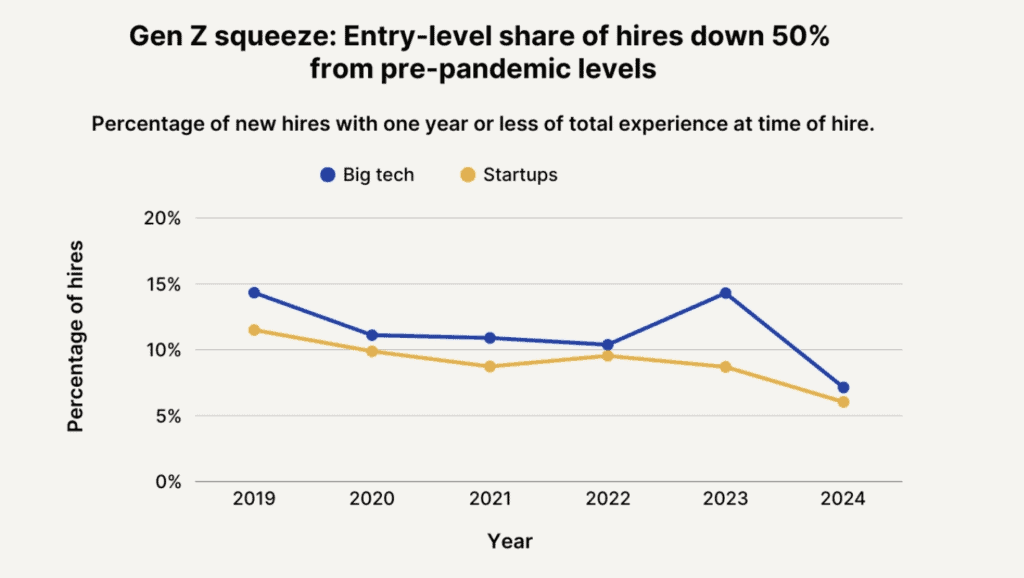
Here’s the uncomfortable truth we need to confront: the traditional entry-level job market is shrinking fast. According to Revelio Labs, entry-level job postings have declined by about 35% since January 2023, with roles most exposed to automation seeing the steepest drop. In the tech sector, the share of new-graduate hires at major firms has fallen over 50% since 2019, based on the SignalFire State of Talent 2025 Report.
Source: SignalFire
The data-heavy, spreadsheet-sorting, email-drafting work that once helped young professionals “learn the ropes” is increasingly being automated. Companies like Shopify have explicitly told employees no new hires unless AI can’t do the job, a policy confirmed by CEO Tobi Lütke in an internal memo. Other large employers are also adopting AI tools to streamline routine junior-level tasks, reducing traditional entry-level openings.
However, this transformation isn’t driven by AI alone. As Revelio Labs notes, broader factors like economic slowdowns, hiring freezes, and efficiency pressures are also constraining early-career hiring.
This isn’t a crisis, it’s a turning point. The path into professional life is being rewritten. Young people can no longer wait for “entry-level permission” to learn; they must actively build portfolios, demonstrate skills, and define their professional identity in new, self-directed ways.
The Emerging Playbook
1. The Portfolio Career Is Now Standard Operating Procedure
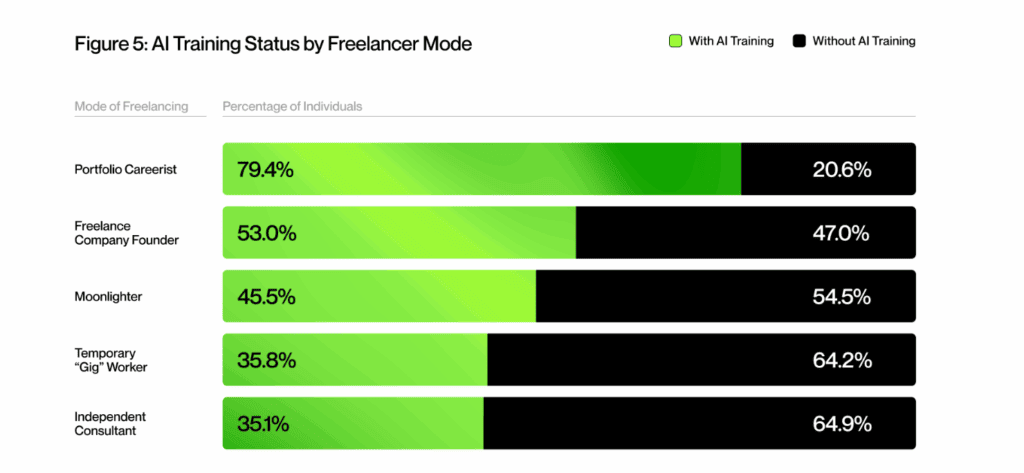
More than half of Gen Z is already redefining “full-time work.” According to Upwork, 53% of Gen Z professionals now work full-time hours across multiple freelance or project-based roles, while 70% prioritize flexibility and autonomy over a steady paycheck. This isn’t about side hustles, it’s about building a career from multiple income streams and skill-growth paths.
Source: Upwork
What this means: think like an entrepreneur from day one. Build in public, document your learning, and turn projects, paid or self-directed, into proof of skill. Your GitHub commits, YouTube tutorials, or design portfolio become your credentials, not a company title that may never materialize.
2. Apprenticeships Are Having a Renaissance
As white-collar entry-level roles contract, apprenticeships are surging. The U.S. Department of Labor has invested over $171 million to expand programs across cybersecurity, clean energy, and healthcare. Modern apprenticeships now reach beyond trades, with new openings in software development, early education, and public transit.
Most apprentices earn while they learn, often starting near $20 per hour and advancing toward $70 000–$80 000annually after completion, depending on field and region. The result: practical skills, pay from day one, and little to no debt.
3. Skills Over Credentials—But the Right Kind of Skills
The college-to-career pipeline is breaking down. Surveys show that 49% of Gen Z workers believe AI has reduced the value of their college degrees, and those aged 18–24 are 129% more likely than older workers to fear AI will replace them. Degrees alone no longer differentiate; performance and adaptability do.
What matters now:
-
AI literacy — Knowing how to prompt, verify, and refine AI outputs.
-
Human skills — Negotiation, empathy, and leadership that resist automation.
-
Domain expertise — Judgment-based skills in healthcare, design, and skilled trades.
-
Hybrid fluency — The Burning Glass Institute notes that many entry-level tech roles now blend business and technical abilities, rewarding “translator” talent.
4. The “Learn by Doing” Model Must Happen Outside Traditional Employment
If you can’t learn on the job, learn outside it. The next generation is building real experience through independent projects and open collaboration.
-
Project-based learning: Take freelance or volunteer work, even at low pay, to build results you can show.
-
Open-source contributions: Participate in public projects to gain skill and visibility.
-
Create rather than consume: Launch a newsletter, app, or campaign, even unpaid work compounds into proof of ability.
-
Micro-credentials: Verified certificates from Coursera, AWS Training, or Google Career Certificatesnow matter more than generic degrees.
The Takeaway
The traditional career ladder is being replaced by a build-and-prove model. Gen Z isn’t opting out, they’re reconstructing work around autonomy, skills, and output. Apprenticeships, freelancing, and project credentials have become legitimate entry points to stability. The rulebook has changed: don’t wait to be hired, train yourself in public.
The Jobs That Remain – and Why
Construction, skilled trades, personal services, and healthcare roles remain among the least threatened by AI automation. These jobs rely on physical presence, human judgment, empathy, and manual dexterity, capabilities that AI still struggles to replicate. Healthcare stands out as one of the strongest growth sectors, with nurse practitioner employment projected to rise 46% from 2023 to 2033, as AI tools enhance rather than replace clinical care.
At the same time, demand is soaring for professionals building and managing AI systems. AI and data science specialists and cybersecurity experts rank among the fastest-growing roles, with starting salaries for entry-level AI workers increasing by roughly 12% between 2024 and 2025. The people designing, securing, and directing the very systems reshaping the job market are, paradoxically, those most in demand.
What We’re Seeing Right Now
Several trends are crystallizing
The Death of the Junior Associate Model: Across law, consulting, and finance, early-career roles are rapidly being reshaped. Legal tech platforms now generate first-draft motions and filings in minutes, tasks that once took junior associates days. Similar automation is spreading through consulting and finance, where entry-level analysts and associates traditionally handled repetitive modeling, research, and reporting work.
Early Entrepreneurship Becoming Necessity: Gen Z is turning to self-employment at record rates. Surveys show that roughly two-thirds of workers aged 18 to 24 either have a side hustle or plan to start one, a shift driven by fewer entry-level openings and the desire for autonomy. What began as supplemental income is evolving into a primary path for skill-building and financial independence.
The Compression of Career Timelines: As AI absorbs routine “apprenticeship” work, traditional 2-to-3-year learning periods are collapsing. Young professionals must now develop senior-level capabilities earlier, favoring those who self-direct their learning, build visible portfolios, and demonstrate value quickly.
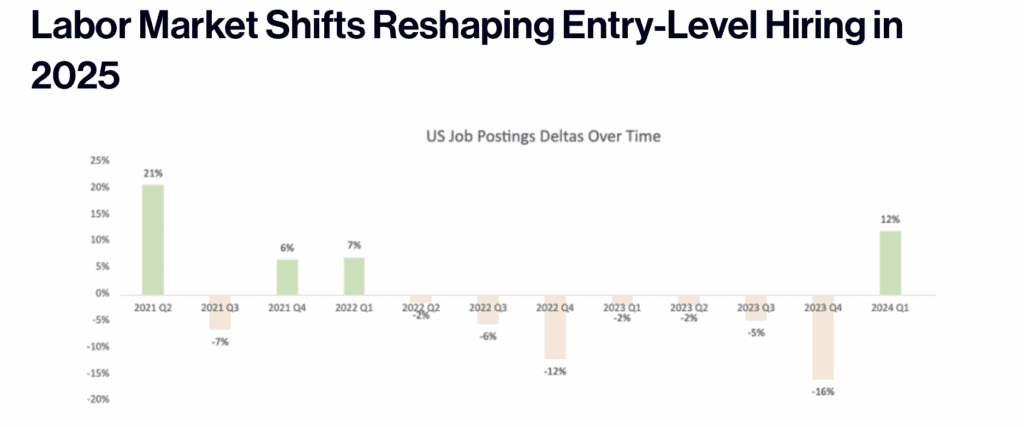
Structural Barriers Intensifying: For the first time in more than 40 years, the unemployment rate for recent college graduates aged 22 to 27 exceeds the national average, according to Federal Reserve Bank of New York data. Meanwhile, entry-level job postings dropped roughly 35–38% in 2023, and remaining listings increasingly demand prior experience or AI-related skills.
Source: AURA
The Brutal Honest Assessment
Young people need to hear this clearly: waiting for someone to teach you is no longer a viable strategy. The companies that once invested in training entry-level employees are now replacing those mentorship pipelines with artificial intelligence. Tasks that once served as learning opportunities are being automated, leaving fewer on-ramps for traditional career development. In this new environment, success requires initiative, adaptability, and an entrepreneurial mindset.
The winners in this transition will be those who take ownership of their growth. They’ll build demonstrable skills outside formal structures, develop real expertise in areas where AI still struggles, like judgment, creativity, empathy, and human understanding, and create their own opportunities rather than waiting for them. Instead of competing with machines, they’ll learn to harness AI as a partner to amplify their capabilities. Many will pursue alternative paths such as apprenticeships, freelancing, and project-based learning, recognizing that these routes are no longer “second best” but essential.
This shift isn’t pessimistic, it’s pragmatic. The traditional career ladder is being dismantled, but ladders were never the only way to climb. The next generation will build new paths entirely, ones defined by self-direction, proof of ability, and the confidence to navigate a future without a predefined map.