
From Journalism to Law: Ranking Common Degrees by AI Exposure Risk


In 2025, choosing a college major means weighing not just job prospects, but whether your chosen field will still exist in its current form. Generative AI is transforming white-collar professions once considered “safe,” and families must now assess degrees through the lens of automation risk and AI collaboration potential.
- AI Disruption Expands Beyond Manual Work: A Brookings Institution (2024) study finds over 30% of U.S. workers have at least half their job tasks exposed to AI, especially in business, finance, law, and design.
- Exposure ≠ Replacement: As MIT’s David Autor notes, AI may augment expertise, boosting wages for high-skill roles while eroding entry-level pathways and routine tasks.
- High-Risk Majors (3–8 Years): Journalism, graphic design, and entry-level creative roles face early disruption as generative AI automates core content and layout functions.
- Medium-Risk Majors (5–10 Years): Law, business administration, and architecture are vulnerable where work is standardized or documentation-heavy, but resilient in strategic, creative, or client-facing specializations.
- Resilient Degrees: Healthcare, education, counseling, AI/ML, and human-centered design programs retain strength thanks to empathy, creativity, and problem-solving demands that resist automation.
The college application season brings familiar questions: Which major should you choose? What career path offers the best prospects? But in 2025, families face an unprecedented new factor in these decisions – the rapid advance of artificial intelligence and its potential to reshape entire professions.
For the first time in history, students choosing a major must consider not just current job markets, but whether their chosen field will even exist in its current form by the time they graduate. This isn’t speculation or fear-mongering. It’s based on comprehensive research analyzing which occupations face the greatest exposure to AI-driven disruption.
The answers may surprise you. Unlike previous waves of automation that primarily affected blue-collar manufacturing jobs, generative AI is poised to disrupt cognitive, white-collar work – precisely the fields that college degrees have traditionally prepared students to enter.
The Research: AI’s Unprecedented Reach
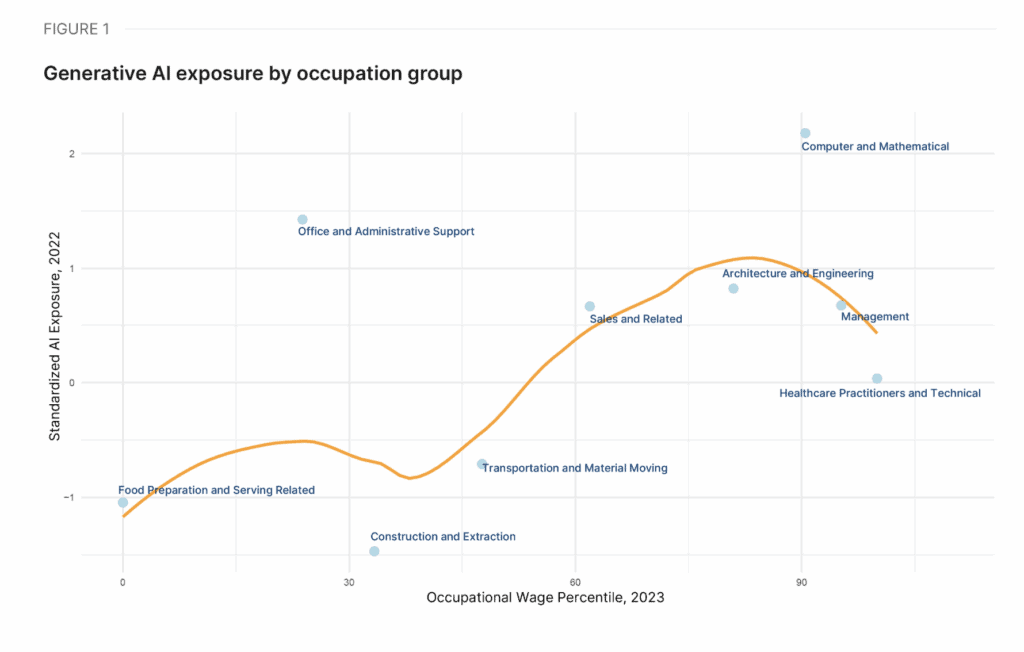
A 2024 Brookings Institution study using data from OpenAI to analyze more than 1,000 U.S. occupations found that generative AI could significantly reshape the nature of work. The report estimates that over 30% of workers may have at least half of their job tasks exposed to AI capabilities, while about 85% could see at least 10% of their work affected.
Unlike previous waves of automation, which mainly displaced routine, manual, or clerical labor, generative AI reaches deep into highly cognitive, non-routine work typically performed by well-educated, higher-income professionals. Brookings researchers describe this shift as one that “upends the traditional automation paradigm,” as AI increasingly encroaches on white-collar domains such as research, writing, data analysis, and presentation design.
Source: Bookings
The implications for students choosing college majors are profound. The fields with the highest exposure to AI are largely knowledge-based sectors, including business and finance, law, engineering, and related professional services, where many roles require advanced degrees and rely on the very skills generative AI can now replicate or augment.
Understanding “Exposure” vs. “Replacement”
Before diving into specific degrees, it’s crucial to understand what researchers mean by “exposure.” As MIT economist David Autor emphasizes, exposure doesn’t automatically mean job loss or replacement.
Autor’s research shows that automation can both replace and augment expertise, depending on which types of tasks are affected. When automation removes routine or low-skill tasks and aids expert tasks, roles often become more specialized and valuable, leading to higher wages even if total employment falls. Conversely, when automation removes expert tasks or lowers entry barriers, employment may rise but wages can stagnate or decline.
In short, the key question isn’t whether AI can perform tasks in your field, it’s how AI will reshape the structure of work itself: Will it eliminate entry-level pathways, compress earnings premiums, or redefine what your degree ultimately prepares you to do?
High-Risk Degrees: Near-Term Disruption (3-8 Years)
Journalism and Media Studies
AI’s impact on journalism is already visible and measurable. Research on AI in journalism shows that generative AI tools now automate content creation, summarization, transcription, and editing, core functions that journalism degrees traditionally train students to perform.
Major news organizations have already integrated AI into their workflows. The Associated Press has long used automation to generate thousands of corporate earnings stories each quarter. Meanwhile, publications such as the BBC and Reuters use AI for data analysis, topic discovery, and workflow optimization, reflecting a broader industry trend toward AI-assisted reporting.
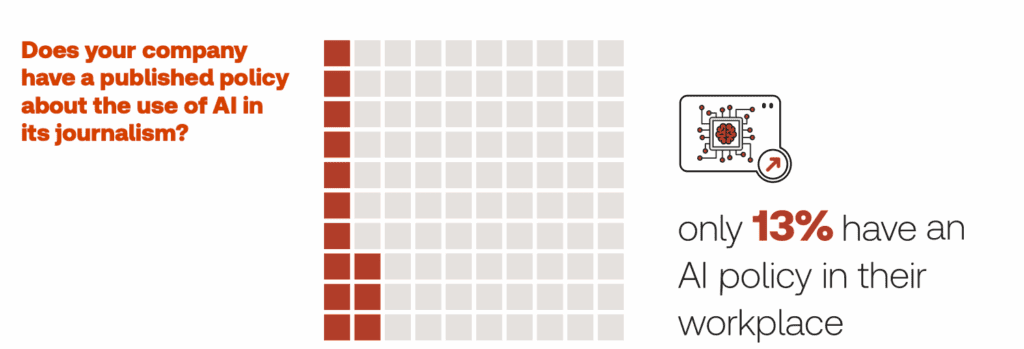
According to a 2025 Thomson Reuters Foundation report, more than 80% of surveyed journalists across 70 countries already use AI tools in their work, primarily for drafting, editing, transcription, and research. Yet only 13% of newsrooms have formal AI policies, and most journalists learned these tools independently rather than through structured training.
Source: Trust.org
The concern isn’t that journalism will disappear, it’s that the value proposition of a traditional journalism degree may erode as AI takes over much of the basic content production and data gathering that once differentiated trained journalists from general writers. As one respondent in the Reuters survey warned: “I fear AI would render a huge majority of journalists jobless due to loss of work to AI-powered systems.”
What this means: Students passionate about journalism should prioritize programs emphasizing investigative reporting, data journalism, multimedia storytelling, and human–AI collaboration, rather than those focused solely on basic writing or editing.
Graphic Design and Visual Arts (Entry-Level)
AI image generation tools have rapidly achieved capabilities that threaten entry-level design work. Generative AI can now create graphics, layouts, and even UI mockups from text prompts, automating what were once foundational tasks for junior designers.
A Brookings Institution analysis notes that visual arts and design occupations face significant AI exposure, especially in routine creative work such as layout design, image editing, and standard graphic production. Similarly, industry research highlights that tools like Midjourney, DALL·E, and Adobe Firefly now handle many of the repetitive tasks once assigned to entry-level designers.
What this means: Design programs that emphasize human-centered design, experience design, strategic problem-solving, and interaction design will likely retain stronger long-term value than those focused mainly on technical execution.
Medium-Risk Degrees: 5-10 Year Horizon
Law (Particularly General Practice)
The legal profession presents a complex picture. Goldman Sachs Research estimates that about 44% of tasks performed in legal professions could be automated by generative AI. These include document analysis, contract review, legal research, and administrative work, core activities that make up much of a lawyer’s day-to-day workload.

Source: Goldman Sachs
The 2024 Clio Legal Trends Report similarly found that roughly 69% of paralegal billable tasks and 57% of lawyer billable tasks could be automated, particularly in document review and routine drafting, roles historically handled by junior associates and paralegals.
However, the impact differs sharply across specializations. Degrees and practices centered on transactional work, compliance, or standard documentation face the highest exposure. By contrast, areas demanding complex negotiation, litigation strategy, client relationships, or specialized regulatory knowledge remain far less vulnerable.
What this means: Law students should specialize early, cultivate strong client-relationship and strategic-thinking skills, and learn to use AI as an augmenting tool rather than viewing it as competition.
Business Administration and Generic Marketing
According to Brookings Institution research, business and financial-operations roles show some of the highest exposure levels to generative AI. Many business-school curricula emphasize management, marketing, and operations, fields that increasingly rely on skills now being replicated by AI systems: data analysis, reporting, strategic planning, and decision optimization.
Generic marketing degrees are especially under pressure. Modern AI platforms can now generate ad copy, analyze campaigns, predict consumer behavior, and allocate ad spend, automating functions that once required entire teams of marketing professionals.
What this means: Business programs that integrate technical depth, such as analytics, AI implementation, or digital-transformation strategy, or domain-specific knowledge like healthcare or sustainability management will likely retain more long-term value than broad, generic business-administration paths.
Architecture (Technical Focus)
Architecture degrees focused heavily on design drafting and technical modeling now face higher exposure to automation through generative-design algorithms, parametric-modeling tools, and AI-based rendering systems. Goldman Sachs Research places architecture and engineering professions at roughly 37% automation exposure, confirming that many technical functions are vulnerable to rapid digitization.
Still, not all architectural work is equally at risk. Programs emphasizing sustainable design, urban planning, human-scale solutions, and complex stakeholder management are less immediately affected because these areas rely on creativity, contextual judgment, and multidisciplinary collaboration, skills that AI cannot yet replicate.
What this means: Students should choose architecture programs that balance technical expertise with design thinking, sustainability, and human-centered problem-solving instead of focusing solely on technical execution that AI can increasingly automate.
Lower-Risk Degrees: What Resists Automation
Not all cognitive work faces equal AI exposure. Research shows several traits make certain fields more resistant to automation:
High human interaction and empathy: Healthcare, counseling, teaching, and social work rely on emotional intelligence and nuanced understanding AI can’t replicate.
Complex physical manipulation: Skilled trades, hands-on healthcare, and physical therapy combine mental and physical precision beyond current AI and robotics.
Creative judgment and strategy: Strategic thinking, ethical reasoning, and creative problem-solving in new situations remain distinctly human.
AI and technical skills: Degrees in AI, machine learning, data science, cybersecurity, and software engineering are in rising demand to build and manage automation systems.
The STEM Exception – With Caveats
STEM degrees tend to show greater resilience to AI disruption, but with important nuances. Programs in computer science and engineering that emphasize AI implementation, system design, and problem-solving are experiencing strong demand. However, even within STEM, some roles face growing pressure, routine coding and other repetitive technical tasks are increasingly automated or AI-assisted.
The key differentiator is whether the degree equips students to work with AI and tackle novel problems, or primarily trains them to execute predictable technical work that AI can now perform efficiently.
What Students and Parents Should Consider
Based on this research, here’s practical guidance for families making college decisions:
Ask these questions about any degree program:
-
Does the curriculum explicitly address AI and how to work with it?
-
Does it emphasize uniquely human skills, creativity, judgment, and interpersonal dynamics, alongside technical knowledge?
-
Are graduates trained to solve novel problems, or mainly to execute established procedures?
-
Does the program provide specialized, hard-to-automate expertise or generic training?
Consider these strategies:
-
Choose programs that combine domain expertise with digital literacy.
-
Prioritize degrees offering internships and real-world problem-solving projects.
-
Look for curricula that integrate AI tools and emphasize human–AI collaboration.
-
Consider double majors or minors pairing passion areas (e.g., psychology, design, communications) with analytical or technical skills (e.g., data science, programming).
Remember these caveats:
-
Exposure timelines are estimates, not certainties, AI adoption varies by field and region.
-
Strong institutions often preserve degree value through networks and curriculum adaptation.
-
Individual outcomes differ widely even within the same major.
-
The goal isn’t to avoid all AI exposure, but to position yourself to work with AI, not be replaced by it.
The Bottom Line
The honest answer depends on what your major teaches and how it’s taught. A journalism degree focused only on basic news writing faces a very different future than one emphasizing investigative reporting, multimedia storytelling, and data analysis. Likewise, a business degree centered on generic management differs sharply from one built around AI-driven analytics, automation, and digital transformation.
Over 30% of workers could see half their tasks disrupted by generative AI, especially in cognitive and white-collar roles. Yet research by MIT economist David Autor shows that automation can also enhance expertise when it removes repetitive work and expands higher-level problem solving.
For families investing heavily in higher education, these insights matter. The degrees most resistant to AI disruption are those that emphasize human creativity, emotional intelligence, adaptability, and ethical judgment, skills machines still can’t replicate.
The best majors in 2025 aren’t those untouched by AI (they barely exist), but those that teach students to leverage AI as a tool. Choose a degree that prepares you to thrive in a future where AI handles routine tasks, and you focus on strategy, innovation, and human connection, the traits that define lasting career success.