Why Most Investors Lose Money Chasing Alpha (And What Actually Works)

Published: Sep 30, 2025

5.7 min read

Updated: Dec 22, 2025 - 09:12:07

Why Most Investors Lose Money Chasing Alpha (And What Actually Works)
ADVERTISEMENT
Advertise with Us
Alpha, returns above a benchmark after adjusting for risk, is the holy grail of investing, but decades of research show that most investors fail to capture it. High fees, bad timing, and market realities make consistent outperformance rare. Instead, evidence from SPIVA, Dalbar, and leading economists like William Sharpe and Eugene Fama shows that low-cost, diversified index investing paired with long-term discipline is far more reliable for building wealth.

  • High fees erode gains: Sharpe’s arithmetic of active management shows active funds as a group underperform after costs. A 1% annual fee can reduce a $100,000 portfolio’s 20-year growth by $80,000.
  • Behavior hurts returns: Dalbar data finds average investors underperform due to overconfidence, loss aversion, and herding behavior.
  • Evidence is overwhelming: SPIVA scorecards show 80–85% of active funds lag benchmarks over 10–15 years.
  • Indexing wins: Low-cost index funds with expense ratios near 0.03% consistently beat most active managers after fees (Vanguard, Fidelity, BlackRock).
  • Time beats timing: Missing the 10 best days in the S&P 500 between 1990–2020 cut returns nearly in half, showing the value of staying invested.
In finance, alpha represents the return an investment generates above its benchmark, after adjusting for risk. For example, if the S&P 500 delivers an 8% return in a given year and a fund posts a 10% return with comparable volatility, the extra 2% is considered alpha. On the surface, this promise of “beating the market” is enticing, but decades of research show that capturing consistent alpha is exceptionally rare. In fact, most investors lose money chasing it due to high costs, poor timing, and structural market realities.

Why Most Investors Struggle to Capture Alpha

High Fees and the Arithmetic of Active Management

Nobel Prize, winning economist William Sharpe laid out a simple but powerful truth known as the arithmetic of active management: because all investors collectively are the market, the group’s performance before fees must equal the market. Once fees are deducted, active managers as a whole underperform.

This principle has practical consequences. Many actively managed mutual funds and hedge funds charge expense ratios of 1% or more, not including trading costs. Over time, those seemingly small fees compound dramatically. A $100,000 portfolio earning 8% annually will grow to about $466,000 in 20 years with no fees. With a 1% annual fee, however, the ending value drops to roughly $386,000. That $80,000 gap illustrates why even modest outperformance is often erased once costs are factored in.

Bad Timing and Cognitive Biases

Even when investors choose capable managers, their own behavior often undermines results. Behavioral finance highlights several common pitfalls:

  • Overconfidence leads investors to believe they can consistently identify winners, but frequent trading usually increases costs and tax liabilities.

  • Loss aversion causes investors to sell winning positions too soon to lock in gains, while holding on to losing positions in the hope of a rebound.

  • Herding results in buying during market euphoria at inflated prices and selling in panic during downturns.

Dalbar’s annual Quantitative Analysis of Investor Behavior has consistently found that the average equity mutual fund investor underperforms the market by several percentage points annually, largely due to poor timing decisions.

Evidence from SPIVA and Long-Term Studies

The S&P Indices Versus Active (SPIVA) scorecards, published by S&P Dow Jones Indices, provide one of the most comprehensive looks at active management. Over 10–15 year horizons, 80% to 90% of active funds across equity and fixed-income categories underperform their benchmarks. These results are remarkably consistent across geographies and market cycles.

Academic research, including studies by Eugene Fama and Kenneth French, confirms these findings, showing that excess returns achieved by active managers are generally indistinguishable from luck once fees and risk are considered.

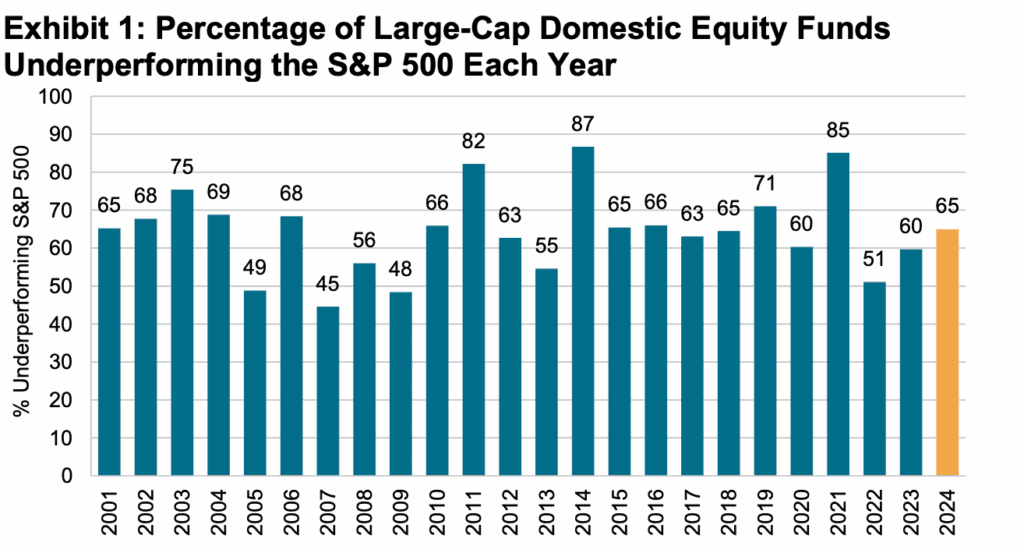
The S&P Indices Versus Active (SPIVA) Scorecards published by S&P Dow Jones Indices provide one of the most comprehensive looks at active management. According to the SPIVA U.S. Year-End 2024 Scorecard, over a 10-year horizon, at least 80% of U.S. equity funds underperformed their benchmarks after fees across all categories, and over 15 years, the rates often exceed 85% depending on category.

U.S. equity funds

Source: SPIVA

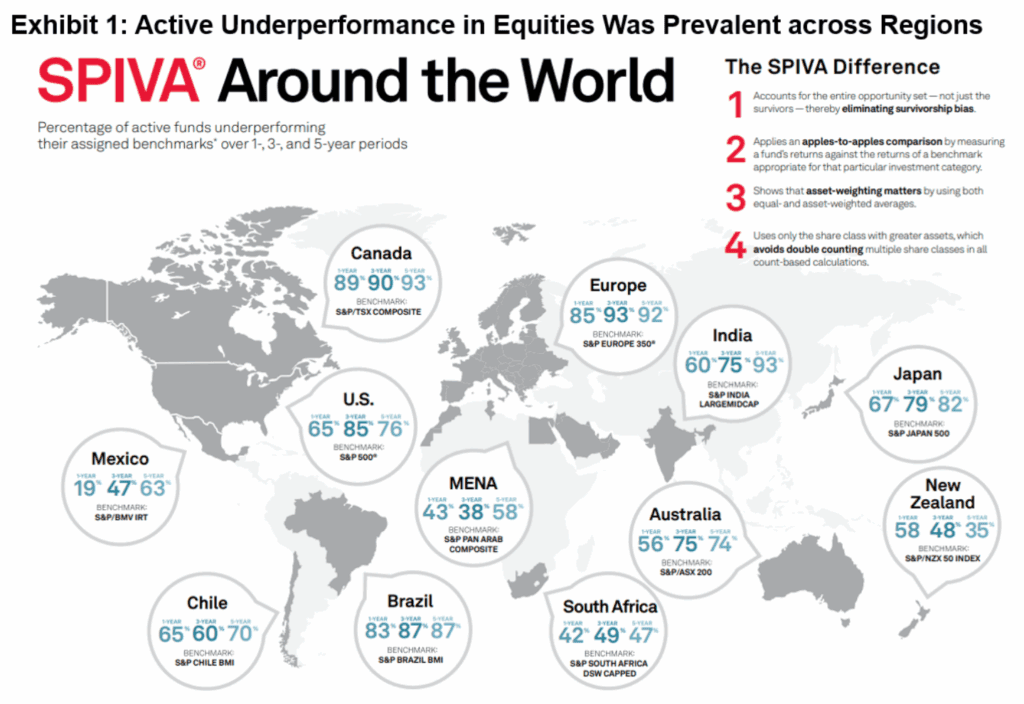
These results are remarkably consistent across geographies and market cycles. The SPIVA Canada Year-End 2024 Report shows that more than 85% of Canadian equity funds underperformed their benchmarks over 15 years, while SPIVA Europe and global scorecards report similar long-term underperformance trends across developed and emerging markets.

Active Underperformance in Equities

Source: S&P Global

What Actually Works for Long-Term Investors

Diversification and Index Funds

Low-cost index funds from providers like Vanguard, Fidelity, and BlackRock allow investors to mirror market performance at minimal cost. Decades of evidence show that these funds, with expense ratios as low as 0.03%, consistently beat the majority of actively managed funds after fees. The widespread availability of ETFs has further democratized access, enabling diversification across asset classes, geographies, and sectors with a single purchase.

Keeping Costs Low

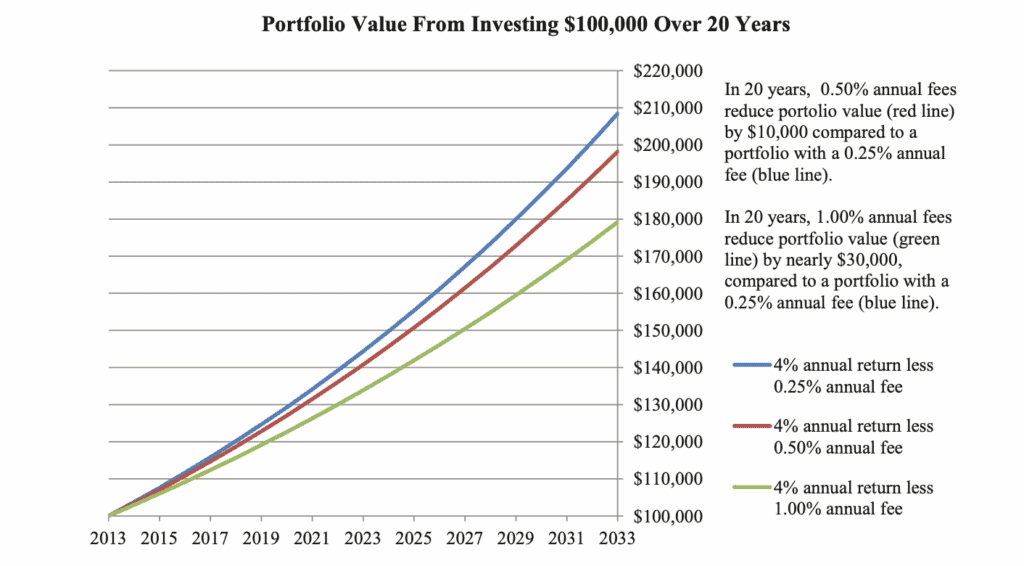
Costs are among the few factors investors can directly control. The SEC has highlighted that a 1% difference in annual expenses can translate into tens of thousands of dollars lost over decades. Choosing funds with rock-bottom expense ratios ensures more of an investor’s money compounds over time.

Mutual Fund Fees and Expenses

Source: SEC

Time in the Market vs. Market Timing

Market history underscores the importance of staying invested. Consider the S&P 500 between 1990 and 2020: an investor who stayed invested earned roughly 9.9% annually. Missing just the 10 best days cut returns nearly in half. Since many of the best days occur during volatile downturns, attempts to time the market often lead to missing rebounds. A simple buy-and-hold approach, though emotionally challenging during downturns, has proven far more effective than frequent trading strategies.

Theory Meets Practice: Fama, Sharpe, and Buffett

Eugene Fama’s Efficient Market Hypothesis (EMH) argues that markets incorporate all available information into prices, leaving little room for consistent outperformance. Sharpe’s arithmetic reinforces why, collectively, active managers cannot beat the market after costs.

Even iconic investors emphasize these realities. Warren Buffett, despite his own record of outperformance, has repeatedly advised most individuals to invest in a simple S&P 500 index fund. In his famous decade-long bet against hedge funds, Buffett wagered that a low-cost index fund would outperform a portfolio of hand-picked hedge funds. He was right, the index fund delivered a 7.1% annualized return, while the hedge funds managed only 2.2%.

Bottom Line

The pursuit of alpha has undeniable allure, but history, mathematics, and psychology all point to the same conclusion: most investors fail to capture it, and many pay a steep price in the attempt. The more sustainable path to building wealth is grounded in fundamentals, keep costs low, diversify broadly, and remain invested for the long haul. While the dream of market-beating returns may be exciting, the evidence shows that patience and discipline, not alpha-chasing, are the real drivers of long-term financial success.

ADVERTISEMENT
Advertise with Us

Related Posts

Other News
ADVERTISEMENT
Advertise with Us

Tags