
Why Your ‘Cheap’ Car Actually Costs $600+ Per Month (And How to Cut It in Half)


That “cheap” car with a $300–$400 monthly payment can still cost $600–$1,000+ per month once insurance, fuel, maintenance, and depreciation are included. Research from the Federal Reserve, Insurance Information Institute, Federal Highway Administration, AAA, and Consumer Reports shows that total ownership costs routinely surprise drivers who only focus on the loan payment. The bottom line: true affordability comes from considering the lifetime cost of ownership, not just the monthly bill.
- Loan & Lease: Average new-car payments run $600–$650 per month; used cars still cost $450–$550 depending on credit.
- Insurance: Typically $150–$200 per month, but SUVs and urban drivers can pay much more.
- Fuel: At 13,500 miles/year and $3.20 per gallon, gas costs about $145 monthly, rising to $200–$250 for larger vehicles.
- Maintenance & Repairs: New cars average $66–$125 per month; reliable used cars may balance higher repairs with lower depreciation.
- Depreciation: A hidden “payment” of $500–$625 per month on a $30,000 car in year one, the single biggest ownership cost.
According to AAA’s 2024 Your Driving Costs, the average new car costs $12,300 per year ($1,020/month) to own. Buyers who purchase reliable used cars, refinance loans, compare insurance, and drive fewer miles can cut these expenses nearly in half.
A low monthly payment on paper rarely reflects the true cost of car ownership. Even a vehicle advertised as “cheap” can end up costing $600 or more per month once you factor in loan payments, insurance, gas, maintenance, and the hidden drag of depreciation. Research from AAA, the Federal Reserve, the Federal Highway Administration, and Consumer Reports all paint a clearer picture of what car ownership really means for a household budget.
The Real Costs Behind Car Ownership
Loan or Lease Payments
According to the Federal Reserve, average monthly payments for new vehicles often fall in the $600–$650+ range for borrowers with strong credit, while used-car payments are typically in the $450–$550 range depending on credit score. These loan obligations remain one of the largest recurring expenses for many vehicle owners.
Insurance Costs by Vehicle Type
The Insurance Information Institute notes that premiums typically range between $150 and $200 per month, though they vary significantly by age, model, and safety record. A newer SUV or luxury car can cost hundreds more to insure compared to an older sedan or compact. Location matters as well, drivers in urban areas usually pay higher rates than those in rural regions due to accident and theft risks.
Fuel and Mileage Expenses
According to the Federal Highway Administration, the average U.S. driver travels about 13,500 miles per year. With U.S. gasoline prices averaging around $3.20 per gallon and typical fuel efficiency near 25 miles per gallon, drivers spend roughly $145 per month on fuel. Households with longer commutes, larger vehicles, or less efficient engines can easily see this figure climb above $200–$250 per month.

Source: AutoInsurance
Maintenance: New vs. Used
While new cars benefit from warranty coverage and fewer surprise breakdowns, AAA data show that maintenance and repairs typically average about $66 to $125 per month, depending on miles driven and vehicle age. Used cars may require more frequent repairs, but they often balance out with reduced depreciation costs. Consumer Reports reliability ratings can guide buyers toward models that hold up well over time.
Interestingly, Tesla vehicles have the lowest 10 year operating costs of all cars surveyed by Consumer Reports, while Land Rover is the most expensive
Top 5 Cheapest and Top 5 most Expensive 10 Year Costs
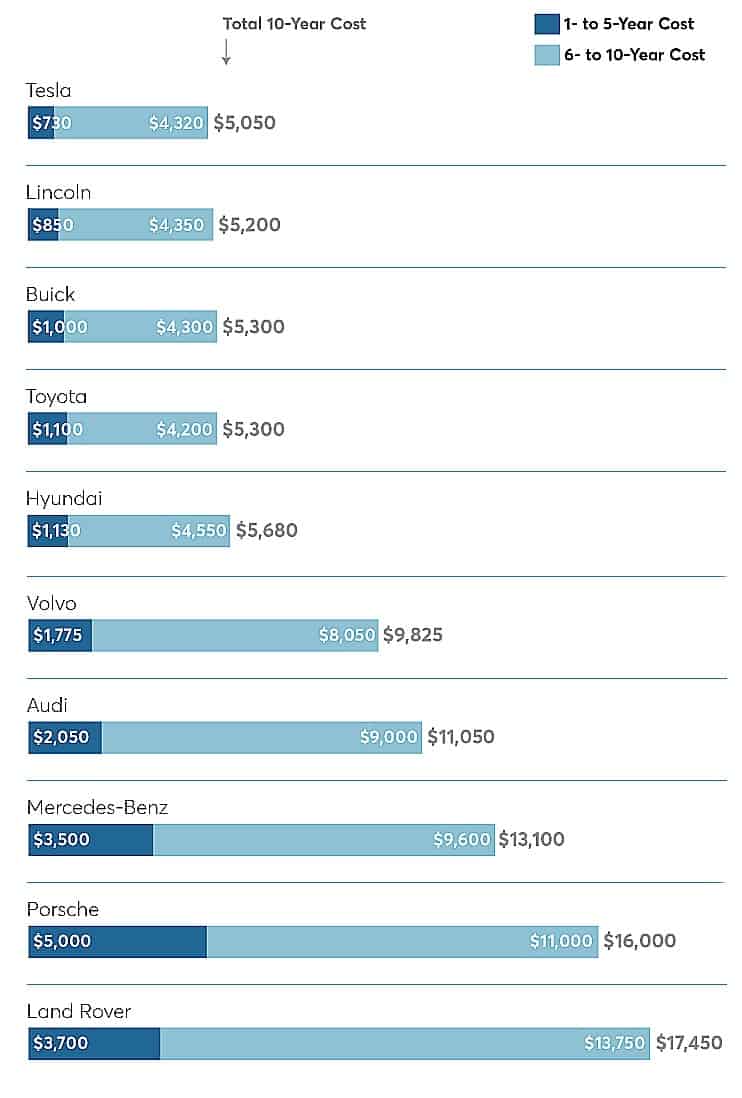
See Consumer Reports for the full chart
Depreciation: The Silent Cost
The largest expense many owners overlook is depreciation. Automotive research consistently shows that new vehicles lose 20% to 25% of their value in the first year. On a $30,000 car, that equals $6,000 to $7,500 in lost value, roughly $500 to $625 per month if averaged across the year, though the steepest drop happens right after purchase. Even after the first year, cars continue to lose value annually, making depreciation a hidden but unavoidable cost of ownership.
What the Numbers Really Show
When all categories are added together, the true cost of driving becomes clear. AAA’s 2024 Your Driving Costs study places the average cost of owning and operating a new vehicle at about $12,300 per year, or roughly $1,020 per month. Even with a modestly priced, fuel-efficient car, most households still spend between $600 and $800 per month once fuel, insurance, maintenance, and depreciation are included. This often surprises drivers who are typically only focused only on their loan or lease payment.
Ride-sharing studies provide another perspective. For people who drive very few miles annually, using Uber or Lyft can be more economical than owning a vehicle. However, for the majority of Americans who log over 12,000 miles per year, car ownership remains the cheaper, but still substantial, option.
How to Cut Car Costs in Half
The good news is that ownership costs can be managed with careful planning and smarter financial strategies:
Buy Reliable Used Models: Depreciation is steepest in the first few years – as mentioned – new cars often lose 20–30% of their value in the first year alone. After about 3 to 5 years, depreciation slows considerably. Purchasing a vehicle with strong reliability ratings during this stage helps avoid the worst of the value drop while still securing dependable transportation.
Refinance or Pay Down Debt Faster: Reducing your auto loan’s interest rate, even by just 2 percentage points, can lower monthly payments and save hundreds, or even thousands, over the life of the loan. If you can, paying extra toward the principal accelerates payoff, cuts total interest, and shortens the repayment timeline.
Compare and Switch Insurance: Insurance rates vary widely, so shopping around regularly can produce significant savings. Many drivers save several hundred dollars per year by comparing policies, and bundling auto with renters or homeowners insurance often brings additional discounts.
Drive Fewer Miles: Cutting just 2,000 miles per year can save around $200–$300 in fuel costs, depending on local fuel prices and vehicle efficiency. Lower mileage also reduces wear and tear and may qualify you for lower-mileage insurance discounts.
Prioritize Preventive Maintenance: Routine upkeep, like $50 spent on oil changes or tire rotations, can help avoid repairs that cost ten times more later. Consumer Reports emphasizes that consistent maintenance is one of the most effective ways to keep cars reliable and affordable over the long run.
Bottom Line
The idea of a “cheap” car is often misleading. Once fuel, insurance, maintenance, and depreciation are included, true costs regularly exceed $600 per month. Yet by buying used, refinancing debt, maintaining regularly, and reducing mileage, drivers can cut ownership costs by as much as half. The key is to look beyond the monthly payment advertised at the dealership and focus instead on the research-backed total cost of ownership that truly reflects the burden, or value, of every car on the road.