Drowning in Credit Card Debt? This Free Service Could Save You Thousands

Published: Sep 19, 2025

5.8 min read

Updated: Dec 19, 2025 - 08:12:38

Drowning in Credit Card Debt? This Free Service Could Save You Thousands
ADVERTISEMENT
Advertise with Us
Nonprofit credit counseling agencies offer government-recognized, affordable debt relief services that help Americans escape high-interest credit card debt. By enrolling in a structured Debt Management Plan (DMP), borrowers can cut interest rates from 20%+ down to 6–10%, consolidate bills into one monthly payment, and become debt-free in 3–5 years. These plans are a safer alternative to for-profit debt settlement companies, which often charge steep fees and deliver poor outcomes.

  • Interest rate reduction: Typical APRs above 20% can drop to 6–10% through nonprofit-negotiated DMPs.
  • Faster payoff: Debts that could take 20+ years with minimum payments are often cleared in 3–5 years.
  • Big savings: Example: $15,000 balance at 22% APR → $30,000+ in interest; with DMP at 8% → ~$7,800 interest, saving $22,000.
  • Consumer protections: Many agencies are HUD-approved and CFPB-recognized, ensuring accountability and transparency.
  • Considerations: Accounts in the plan are closed, small monthly service fees apply, and consistent payments are required.

Nonprofit credit counseling agencies offer free debt relief services that can cut credit card interest rates from above 20% to as low as 6–10%. Through structured Debt Management Plans (DMPs), households can save tens of thousands of dollars in interest, consolidate payments into one monthly bill, and become debt-free in 3–5 years. These services are government-recognized, affordable, and a legitimate alternative to risky for-profit debt settlement companies.

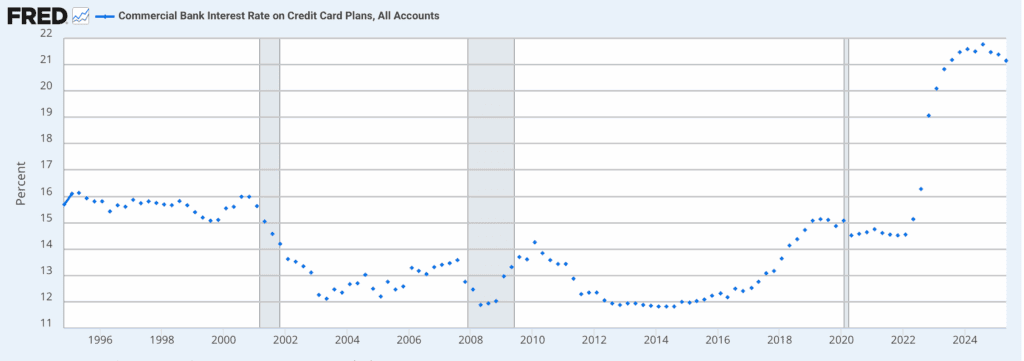
Credit card debt continues to weigh heavily on millions of American households, largely because of soaring interest rates. With the average credit card APR now above 20% according to Federal Reserve data, balances can grow quickly even when borrowers make faithful monthly payments.

Interest Rate on credit card plan

Source: FRED

In many cases, those payments barely touch the principal, with most going toward interest. The result is a cycle of debt that feels impossible to escape. This is where free debt relief services, offered by nonprofit credit counseling agencies, can provide a structured and legitimate path forward.

What Are Free Debt Relief Services?

Free debt relief services are programs run by nonprofit credit counseling agencies. These organizations differ significantly from for-profit debt settlement companies. Instead of charging high upfront fees or making unrealistic promises, they operate under government oversight and recognition, ensuring accountability.

Many of them are approved by the U.S. Department of Housing and Urban Development (HUD) and recognized by the Consumer Financial Protection Bureau (CFPB). This backing means they are required to follow strict standards, provide clear disclosures, and avoid the predatory practices that often plague the for-profit sector.

How Credit Counseling Works

The process usually begins with a free consultation session with a certified counselor. These sessions typically last about an hour and involve a detailed review of your financial situation, including income, expenses, outstanding debts, and budget habits. Counselors provide tailored advice and highlight areas where financial adjustments can be made. Importantly, these sessions come with no obligation to sign up for a program. For many, this step alone offers practical strategies for regaining control over their finances.

When deeper intervention is needed, the counselor may recommend enrolling in a Debt Management Plan (DMP). This plan is one of the most effective ways to reduce interest rates, consolidate payments, and shorten the timeline to becoming debt-free.

How Debt Management Plans Work

Debt Management Plans are not new loans but structured repayment arrangements. The nonprofit agency works directly with creditors to negotiate lower interest rates and, in many cases, the removal of late fees. For example, interest rates that typically range from 18% to 25% may be reduced to between 6% and 10%. Once a plan is in place, borrowers make a single monthly payment to the agency, which then distributes the funds to creditors.

These plans are typically structured to eliminate debts within three to five years. While a modest monthly administrative fee may apply, usually less than $50 and capped by state law, the savings achieved through reduced interest far outweigh these costs. Accounts included in the plan are usually closed, which can temporarily impact credit scores, but the progress made on debt repayment often leads to long-term improvement in credit health.

How Much Can You Save?

The savings from a Debt Management Plan (DMP) can be substantial. Consider this example:

  • Balance: $15,000 across multiple credit cards

  • Average APR: 22%

  • Minimum payment: About $300/month (≈2% of balance, declining as the balance falls)

If you only pay the minimums, it could take more than 20 years to pay off and cost over $30,000 in interest, depending on how the minimum payments are structured.

Now compare with a DMP:

  • APR reduced to: 8%

  • Term: 5 years

  • Monthly payment: ~$380

  • Total interest paid: ~$7,800

That’s a savings of around $22,000 in interest and a debt-free date more than a decade sooner.

Who Qualifies and What to Expect

Nonprofit credit counseling services are usually available to anyone struggling with unsecured debt such as credit cards, medical bills, or personal loans. To enroll in a DMP, borrowers typically need to provide recent account statements, proof of income, and a household budget. Creditors generally require that accounts included in the plan be closed, but the relief of a clear repayment strategy and reduced financial stress often outweighs the short-term drawbacks.

Pros and Cons of Free Debt Relief Services

Like any financial strategy, DMPs come with trade-offs:

Pros:

  • Free initial counseling sessions

  • Oversight by HUD and federal regulators

  • Significant interest rate reductions (often to 6–10%)

  • One simplified monthly payment

  • Savings of thousands in interest and faster debt payoff

Cons:

  • Not every creditor may agree to participate

  • Accounts in the plan are closed to new spending

  • Small monthly service fees may apply

  • Requires consistent payments for 3–5 years

Alternatives to Explore

If nonprofit credit counseling isn’t the right fit, other strategies may help:

  • Debt Consolidation Loans: Refinance multiple balances into one loan at a lower interest rate.

  • Balance Transfer Credit Cards: Some offer 0% APR for 12–18 months, ideal for disciplined borrowers.

  • DIY Repayment Strategies: Methods like the snowball (smallest balance first) or avalanche (highest rate first).

  • Bankruptcy: A legal reset for those in extreme financial hardship, but considered a last resort due to long-term credit damage.

How to Find a Legitimate Provider

Choosing the right agency is essential. Legitimate nonprofit credit counseling agencies are often affiliated with the National Foundation for Credit Counseling (NFCC) or the Financial Counseling Association of America (FCAA). They are registered as 501(c)(3) nonprofits and are typically approved by HUD. Consumers should avoid companies that demand large upfront payments, make unrealistic promises of instant results, or pressure individuals into signing agreements without full disclosure.

Bottom Line

Nonprofit credit counseling agencies provide a safe and structured solution for households burdened by high-interest debt. By leveraging government recognition and negotiating power, these agencies can help reduce interest rates from over 20% to as low as 6%, saving borrowers thousands of dollars and years of repayment stress. For those who feel trapped by credit card debt, these services represent not just a financial tool but a path toward lasting stability and peace of mind.

Related: This article is part of Mooloo’s Loans & Credit Hub, covering credit scores, loans, mortgages, credit cards, and smart borrowing decisions:

ADVERTISEMENT
Advertise with Us

Related Posts

Other News
ADVERTISEMENT
Advertise with Us

Tags