
Social Security Timing: The $200,000 Choice Most People Get Wrong

Published: Sep 15, 2025

5.2 min read

Updated: Dec 25, 2025 - 03:12:16

Social Security Timing: The $200,000 Choice Most People Get Wrong
ADVERTISEMENT
Advertise with Us
When you claim Social Security is one of the most important retirement decisions you’ll make. The difference between filing at 62 versus 70 can exceed $200,000 in lifetime income, according to SSA.gov data and financial planning research. Monthly checks are permanently reduced if taken early and permanently increased (up to 32%) if delayed until age 70. Health, work status, and spousal coordination all influence the best claiming age, making personalized planning critical.

  • Benefit calculation: Based on your 35 highest-earning years and the age you claim relative to your Full Retirement Age (66–67).
  • Early vs. late claiming: At 62, benefits are cut 25–30%. At 70, benefits rise about 8% per year past FRA, up to 32% higher.
  • Dollar impact: A $2,000 FRA benefit could total $336,000 at 62 vs. $595,000 at 70—nearly a $259,000 gap.
  • Key factors: Life expectancy, health, ongoing work, and spousal/survivor benefits all shape the optimal decision.
  • Planning step: Review your SSA statement, run break-even analysis (typically age 78–80), and consider professional retirement income advice.
Social Security is not just another retirement check, it is one of the most important financial choices you will make. The age at which you decide to claim benefits can create a lifetime swing of more than $200,000, according to research from financial planning organizations. Social Security Administration (SSA) actuarial data confirms that claiming too early can lock retirees into significantly reduced benefits, sometimes costing average earners over $100,000 in lifetime income. For many, this is the single most impactful retirement decision after saving and investing.

How Social Security Benefits Are Calculated

Your benefit is determined by two key factors:

  1. Earnings Record: The SSA looks at your 35 highest-earning years. Years without income count as zeros, which lowers your average.

  2. Claiming Age: The age you start benefits relative to your Full Retirement Age (FRA) affects your monthly check permanently.

FRA ranges between 66 and 67 depending on birth year. Claiming before FRA reduces your check, while waiting increases it. Specifically:

  • At 62 (earliest possible age): A 25–30% permanent reduction in monthly benefits.

  • At FRA (66–67): You receive 100% of your calculated benefit.

  • At 70 (latest possible age): You gain an 8% annual increase after FRA, up to a 32% higher benefit.

This means timing alone, not earnings or contributions, can change your monthly income for the rest of your life.

Real-World Dollar Comparisons

Let’s assume your FRA benefit is $2,000 per month.

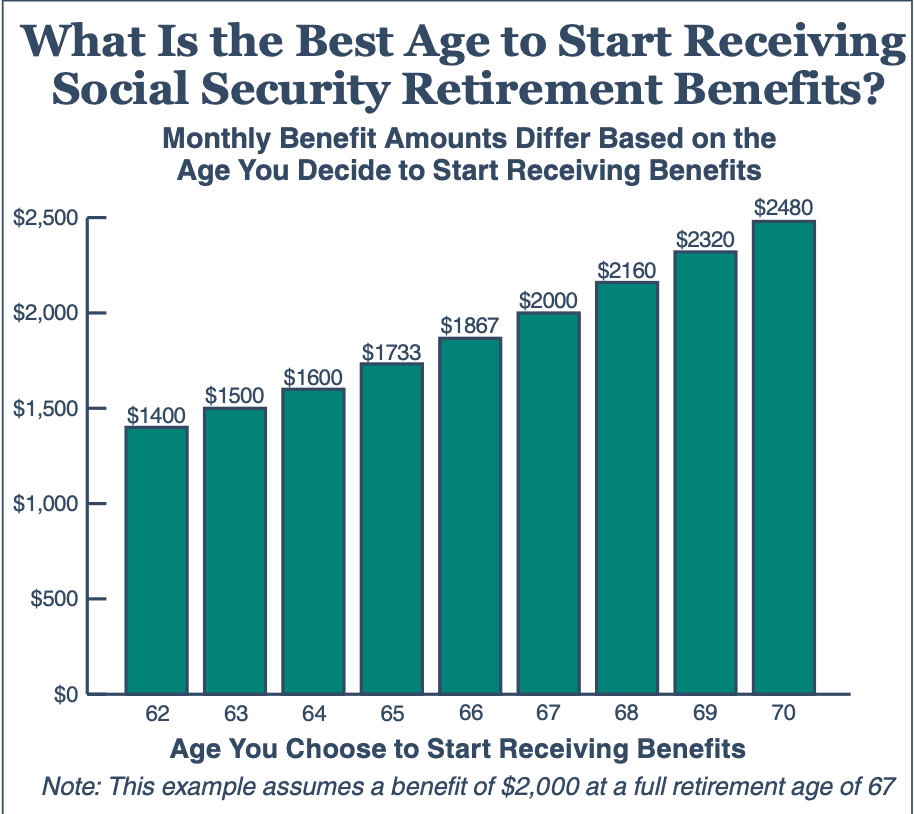
  • Claiming at 62: ~$1,400/month. Over 20 years, that totals about $336,000.

  • Claiming at 67 (FRA): $2,000/month. Over 20 years, about $480,000.

  • Claiming at 70: ~$2,480/month. Over 20 years, nearly $595,000.

That’s a $259,000 difference between 62 and 70, illustrating how timing alone can dramatically affect lifetime retirement income.

Monthly benefit amount increase

source: SSA.gov

Why the $200,000 Lifetime Difference Matters

Most retirees focus on the monthly amount rather than the long-term total. But retirement can stretch 25–30 years. If you live into your 80s or 90s, delaying benefits can add $200,000 or more in cumulative payments. SSA data and financial planning research confirm that these differences are not theoretical, they reflect real outcomes for average retirees.

For healthy individuals with family longevity, waiting to claim is often the smarter financial move. For those with shorter life expectancy, earlier claiming may still be better. This is why timing must be tailored to personal circumstances.

Factors That Influence the Best Strategy

1. Health and Life Expectancy

If health concerns or chronic conditions shorten your expected retirement years, taking benefits earlier ensures you receive them. But if you’re in good health with a family history of longevity, waiting until 70 could provide not only higher lifetime income but also protection against outliving other retirement savings.

2. Working While Claiming

If you claim before reaching FRA and continue working, the earnings test applies. In 2024, earning more than $22,320 triggers temporary benefit reductions. However, these reductions are not lost; once you reach FRA, your benefits are recalculated higher to account for withheld payments.

3. Spousal and Survivor Benefits

Couples should coordinate carefully. A higher-earning spouse delaying until 70 increases not just their own benefit but also the survivor benefit for their partner. This can be a critical factor in ensuring long-term financial stability for widows or widowers.

4. Break-Even Age Analysis

The break-even age is the point when cumulative delayed benefits surpass early claiming. For most people, this falls between ages 78 and 80. Living beyond this age makes waiting financially advantageous, which is why healthy individuals are often advised to delay.

Common Pitfalls to Avoid

Many retirees make costly mistakes when claiming Social Security. One common error is filing at 62 simply because it is the earliest eligible age, without considering the long-term impact. Others overlook how ongoing work income interacts with early claiming, leading to unexpected benefit reductions. Couples sometimes fail to account for how one spouse’s decision affects survivor benefits, leaving the surviving partner with less income. Another mistake is skipping a break-even analysis or personalized scenario planning, which can reveal the best timing based on health and financial needs.

Building a Thoughtful Claiming Plan

The best strategy begins with reviewing your personalized statement at SSA.gov to verify your earnings record and projected benefits. From there, using calculators and retirement planning tools can help model outcomes at different claiming ages, giving you a clearer picture of lifetime totals. Couples should run joint scenarios, especially if one partner has significantly higher earnings.

Health, family history, and immediate financial needs must also be weighed carefully. Those who need cash flow to cover essential expenses may have valid reasons to claim early, while retirees with savings flexibility often benefit more from waiting. For the most tailored approach, consulting a financial planner who specializes in retirement income strategies ensures that you account for all variables.

Conclusion: Small Decisions, Big Consequences

Social Security is a guaranteed lifetime income stream, and the timing of when you claim it can create a six-figure difference in retirement security. For some, the right answer is claiming early to cover essential expenses. For others, particularly healthy retirees with adequate savings, delaying until 70 unlocks the largest long-term advantage.

The difference between 62 and 70 is not just about larger monthly checks; it’s about creating an additional $200,000+ in lifetime income that could define the quality and security of your retirement. Thoughtful planning ensures that this once-in-a-lifetime choice works in your favor.


For a full overview of Social Security benefits, rules, and common questions, see our Social Security Explained guide.

ADVERTISEMENT
Advertise with Us

Related Posts

Other News
ADVERTISEMENT
Advertise with Us

Tags