
Why Betting on Altseason May Leave Investors Empty-Handed


For two years, investors have waited for the next “altseason,” when altcoins surge while Bitcoin consolidates. But in 2025, structural shifts, weak retail participation, and macro headwinds suggest the pattern may break, delaying any meaningful rotation into 2026 or beyond. Investors should be cautious of overexposure to speculative altcoins and instead focus on quality projects or institutional flows.
- Macro pressure: Sticky Fed policy, a stronger U.S. dollar, and Treasury liquidity drain are all bearish for high-risk crypto assets.
- Structural shifts: Bitcoin ETFs dominate inflows ($39.57B AUM as of Jan. 29), while liquidity is fragmented across 44M+ tokens.
- Technical weakness: Bitcoin dominance at ~64% and an Altcoin Season Index of 39 (vs. 75 needed) signal no broad rotation into alts yet.
- 2026 setup: Powell’s term ending, new crypto regulation (Clarity Act), and potential $1.3–$1.9T liquidity injection could reset conditions for altcoins.
- Investor takeaway: Patience and selectivity matter. Bitcoin and Ethereum ETFs attract capital, but most altcoins may struggle until 2026.
For two years, crypto investors have been waiting for altseason, the period when alternative cryptocurrencies surge in value while Bitcoin consolidates. Despite repeated predictions and social media hype, mounting evidence now suggests 2025 could be the year that breaks the cycle entirely, pushing any meaningful altseason into 2026 or later.
The stakes are high: billions in retail and institutional capital remain positioned for a market rotation that key economic indicators and structural changes now suggest is unlikely to occur this year.
The Traditional Altseason Playbook Is Breaking Down
Historically, altcoin seasons have followed a predictable rhythm: Bitcoin rallies to new highs, consolidates, and capital rotates into alternative cryptocurrencies for higher potential returns. This pattern was on full display in 2017 and again in 2020–2021, when Bitcoin’s dominance dropped from 70% to 38% while total altcoin market capitalization more than doubled. On April 16, 2021, the Altcoin Season Index reached 98, signaling one of the strongest rotations in crypto history.
But 2025 is different. As Tuur Demeester observed, “This cycle, Bitcoin is leaving ‘crypto’ in the dust,” while trader San Wouters stated bluntly, “The truth is, there is no more alt season.”
Macro Headwinds Are Against Altcoins
Three major macroeconomic forces are creating unfavorable conditions for altcoin performance:
-
Federal Reserve resistance: In recent FOMC meetings, expectations for rate cuts collapsed. Before the last meeting, markets priced a 55% chance of a cut; afterward, there was a 61% probability there would be no cut at all. The absence of monetary easing is historically bearish for risk assets, including altcoins.
-
Resurgent dollar strength: After falling from 110 to 96 earlier this year, the U.S. Dollar Index (DXY) has rebounded to 99. A stronger dollar reduces global liquidity, making it harder for crypto markets to thrive.
-
Liquidity drain: The U.S. Treasury’s rebuild of the Treasury General Account (TGA) is pulling liquidity from the system. The target is $850 billion by the end of September, meaning roughly $410 billion is being removed from circulation, a major drag on risk markets.
Structural Shifts Disrupting the Cycle
The crypto market has undergone fundamental changes that challenge the old altseason pattern.
Institutional Bitcoin monopolization: Bitcoin funds have accounted for over 90% of all inflows in the digital sector this year. For instance, as of Jan. 29, these funds collectively managed $39.57 billion worth of assets, up from $1.17 billion over a year ago.
Fragmentation of liquidity: With more than 44 million tokens in circulation and roughly 50,000 new ones created daily, capital is spread too thin. As Jack Green notes, “Liquidity is more fragmented than ever,” reducing the potential for any single altcoin to dominate flows.
Lack of retail participation: Retail investor enthusiasm, a key driver of the 2021 bull run, is notably absent. Traders are cycling capital quickly, avoiding the long-term holds that once fueled parabolic runs.
Technical Indicators Tell a Bearish Story
Market metrics further suggest that conditions for altseason are absent.
Bitcoin dominance remains elevated at 63.9%, well above the 50–60% range typically seen before a rotation into altcoins. The Altcoin Market Cap (ALTCAP) recently broke down below key support, and USDT dominance has bounced after forming a double bottom, both bearish signs for alternative cryptocurrencies.
Network activity has also declined. Without a resurgence in real usage, the foundation for a strong altseason remains weak. The Altcoin Season Index currently shows only 39 of the top 100 coins outperforming Bitcoin over the past 90 days, far below the 75 threshold that would signal an altseason.
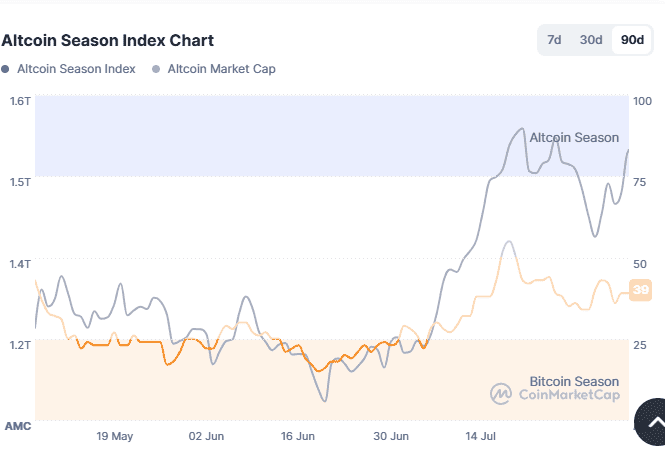
Source: Coingecko
Why 2026 Could Be the Real Opportunity
Several developments could shift the outlook in 2026:
-
A potential Federal Reserve leadership change in early 2026, when Jerome Powell’s term ends, could lead to more aggressive rate cuts under a new administration.
-
The highly anticipated Clarity Act, a regulatory bill promising clearer rules for the crypto sector, is expected to take effect in late 2025 or early 2026.
-
Changes to banking leverage ratios could unleash $1.3–$1.9 trillion in global liquidity by the end of 2026.
Strategic Implications for Investors
Given current conditions, placing heavy bets on a 2025 altseason is a high-risk move. As Ki Young Ju of CryptoQuant warns, “Most altcoins won’t make it” through this cycle, and only projects with strong fundamentals and potential ETF approval are likely to perform well.
For now, Bitcoin continues to benefit from institutional adoption, and central banks may even add it to reserves. Ethereum ETFs have logged 11 consecutive days of inflows totaling over $630 million, an early sign of selective rotation, according to MEXC COO Tracy Jin.
Conclusion: Patience Over Prediction
The data points to a delayed, not dead, altseason. As technical analyst Valdrin Tahiri concludes, “It seems unlikely there will be an altseason in 2025, at least not one close in magnitude to the previous two.” Investors who align their strategies with macro conditions, focus on quality assets, and prepare for a potentially favorable 2026 may be better positioned to capture gains when the rotation finally comes.